Oliver Rodriguez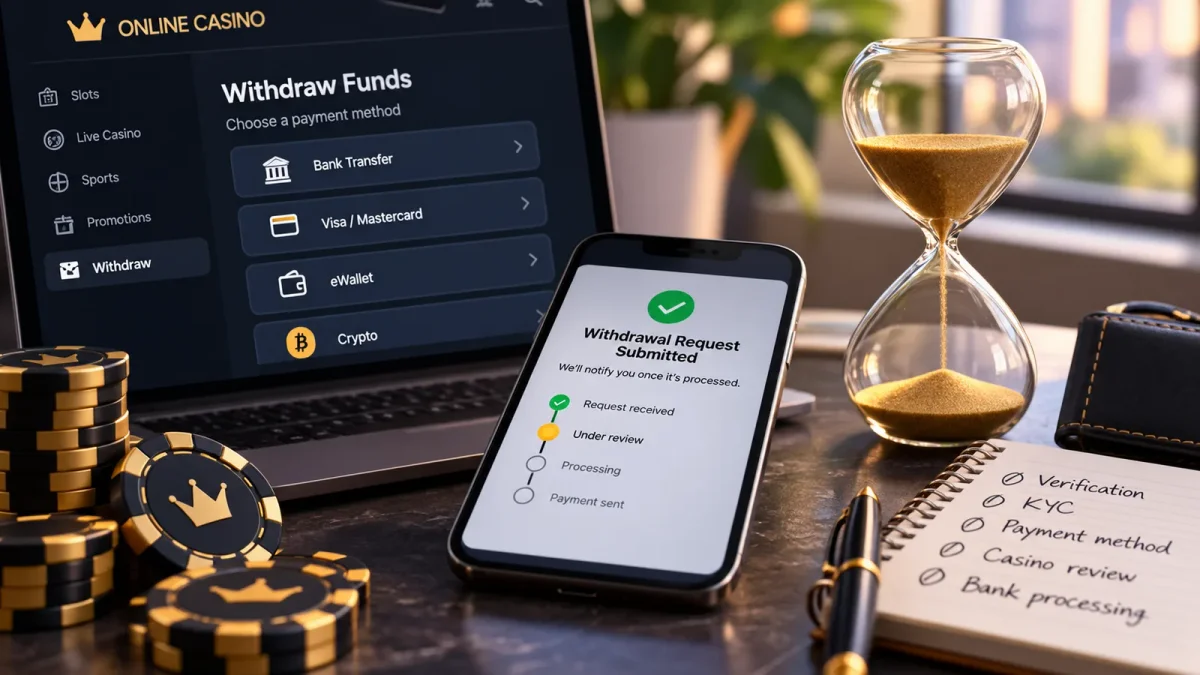
Withdrawing money from an online casino is usually simple: open the cashier, select an eligible payment method, enter the amount and confirm the request. What happens after that click is where most confusion begins.
A withdrawal can pass through several systems before the money reaches a bank account, card, e-wallet or crypto wallet. The casino may first verify that the balance is withdrawable, check the account for security or compliance issues and approve the transaction. Only then does the payment provider take over.
That creates an important distinction:
Casino processing time is not the same thing as total withdrawal time.
An operator can approve a payment within two hours while a card issuer takes another two business days to credit the money. An e-wallet can technically transfer funds almost instantly but still be useless for speed if the casino holds the withdrawal in a review queue for 48 hours.
Casino Critic separates these stages throughout this guide so that terms such as pending, processing, approved and paid actually mean something.
Withdrawal rules also depend on jurisdiction. Great Britain, regulated US states, EU markets and international casinos do not operate under one universal rulebook. Specific regulatory examples are labelled where relevant rather than presented as global law.
This guide is informational and does not encourage gambling. If money is available to withdraw, cashing it out rather than continuing to gamble is always a valid choice.
Casino Critic expert take: When a withdrawal is delayed, the first question should not be “Which payment method did I use?” It should be “Has the casino already approved and released the money?” Until that happens, the speed of PayPal, Visa, a bank or a blockchain is largely irrelevant.
How to Withdraw Money From an Online Casino Step by Step
Most online casino withdrawals follow the same basic process even though the names of individual menus differ.
Before submitting the request, check that the displayed balance is actually withdrawable rather than tied to an active bonus.
- Open The Casino Cashier. Look for Banking, Wallet, Cashier or Withdraw inside the account menu.
- Check Your Withdrawable Balance. Cash, bonus funds and pending rewards may appear separately.
- Choose An Eligible Withdrawal Method. Casinos often prioritise a payment route already used for deposits.
- Enter The Withdrawal Amount. Stay within the minimum and maximum limits shown in the cashier.
- Confirm The Request. Additional two-factor authentication or payment verification can be required.
- Complete Any Legitimate Account Checks. KYC, payment ownership or AML checks may apply depending on the market and account.
- Track The Withdrawal Until It Is Paid. Pending, approved and completed statuses refer to different stages.
After confirmation, the withdrawal normally enters the casino's internal processing system. The payment provider does not necessarily have the money yet.
That is why checking the withdrawal status is more useful than repeatedly checking a bank balance.
The 4 Stages Every Casino Withdrawal Can Pass Through
A casino withdrawal can be understood as four separate clocks. Combining them into one advertised payout time creates most of the confusion around “instant withdrawals”.
| Stage | What Happens | Who Mainly Controls It |
|---|---|---|
| Withdrawal request | Player submits amount and method | Player / casino |
| Casino review | Balance, KYC, payment and security checks | Casino |
| Payment processing | Approved money is sent through payment rail | Casino / payment provider |
| Final settlement | Bank, wallet or blockchain credits funds | Payment provider / bank / network |
The fastest payment method can only affect the final stages.
For example, a casino might approve a PayPal withdrawal in 30 minutes and PayPal can then credit it quickly. Another casino could use the same PayPal network but spend two days reviewing the withdrawal before releasing it.
Both casinos “support PayPal”, but their real payout performance is completely different.
What Does “Pending Withdrawal” Mean at an Online Casino?
A pending casino withdrawal usually means the request has been received but has not yet been fully approved and released to the payment provider.
Pending does not automatically indicate a problem.
The casino may still be:
- Checking the account balance.
- Ru ing automated fraud checks.
- Confirming payment ownership.
- Checking bonus status.
- Waiting for KYC documents.
- Reviewing unusual account activity.
- Confirming the selected withdrawal method.
- Processing requests in a payment queue.
A pending status becomes more significant when it lasts beyond the operator's published processing window.
If the casino says withdrawals are normally reviewed within 24 hours and the request remains pending after several days with no explanation, support should be contacted.
The relevant benchmark is the casino's own published processing time, not an arbitrary promise that all online casino withdrawals should be instant.
Pending, Processing, Approved and Paid – What the Statuses Usually Mean
Casino terminology varies, but most withdrawal statuses fit into a small number of categories.
| Status | Typical Meaning | Where The Money Is |
|---|---|---|
| Requested | Withdrawal has been submitted | Casino account system |
| Pending | Waiting for review or approval | Casino |
| Processing | Casino or payment processor is handling it | Casino / processor |
| Approved | Casino has accepted the withdrawal | Moving toward payment provider |
| Completed / Paid | Casino says funds have been sent | Payment provider / destination |
| Failed | Payment could not be completed | Usually returned to casino balance |
| Cancelled | Withdrawal was cancelled under applicable rules | Casino balance or account review |
The most important transition is Pending → Approved/Completed.
Once a casino marks a withdrawal as completed, the question usually changes from “Why is the casino holding my money?” to “How long does this payment method take to settle?”
That difference helps determine who should be contacted next.
How Long Do Online Casino Withdrawals Take in 2026?
A normal casino withdrawal can take anything from minutes to several business days, depending primarily on the casino's approval process and the selected payment rail.
Modern e-wallets and instant banking methods can receive approved funds very quickly. Card networks and traditional bank transfers can take longer.
| Withdrawal Method | Typical Time After Casino Approval | Main Delay |
|---|---|---|
| PayPal | Minutes to 24 hours at many operators | Casino review |
| Skrill / Neteller | Minutes to 24 hours | Casino review |
| Instant / Open Banking | Minutes to 24 hours | Bank support |
| Apple Pay | Instant to several days | Underlying card / operator support |
| Debit Card | Hours to 1–3 business days | Card issuer |
| Bank Transfer | Hours to 1–5 business days | Bank / transfer rail |
| Crypto | Seconds to hours after broadcast | Casino approval + blockchain |
| Paper Check | Several days or longer | Delivery and banking |
These ranges are directional rather than universal promises.
One current example shows how dramatically payment methods can differ inside the same casino. bet365 currently publishes instant Apple Pay withdrawals, 1–4-hour PayPal and online banking processing, and potentially several banking days for some card payments.
That does not mean every casino follows the same schedule.
The broader Casino Critic payment guides compare withdrawal rails separately because payment method and operator speed should never be treated as the same metric.
Why Is My Casino Withdrawal Taking So Long?
Most delayed casino withdrawals fall into a relatively small number of categories.
Some delays are legitimate and temporary. Others reveal weak payment policies or account problems that should have been addressed earlier.
The most common causes are:
- The Casino Has Not Approved The Withdrawal Yet.
- Identity Verification Is Incomplete.
- The Operator Has Triggered An AML Or Source-Of-Funds Review.
- The Withdrawal Method Does Not Match The Deposit Route.
- Bonus Funds Or Bonus Wi ings Are Still Restricted.
- The Requested Amount Is Outside The Payment Limits.
- The Bank, Card Issuer Or E-Wallet Is Still Processing The Transfer.
- The Withdrawal Was Requested Near A Weekend Or Bank Holiday.
- A Large Or Unusual Withdrawal Triggered Manual Review.
- The Payment Details Are Incorrect Or No Longer Valid.
The correct response depends on which stage caused the delay.
Uploading the same passport repeatedly will not fix a card processor delay. Calling the bank will not help if the casino still shows the withdrawal as pending.
Find the stage first, then solve the problem.
Reason 1: The Casino Is Still Reviewing the Withdrawal
Internal casino processing is often the largest hidden part of total payout time.
Even when the payment method itself can settle almost instantly, the operator may first perform:
- Balance checks.
- Fraud screening.
- Duplicate-account checks.
- Payment matching.
- Bonus compliance review.
- KYC review.
- AML monitoring.
Current casino policies vary dramatically.
Some operators aim to approve withdrawals within a few hours. Others publish 24-hour review periods, while slower sites can reserve several business days.
This is why “PayPal in 15 minutes” can be misleading if it describes only what happens after approval.
Casino Critic expert take: A payment method should be judged from the moment Withdraw is pressed, not only from the moment the casino finally sends the transaction.
Reason 2: Casino KYC Verification Is Incomplete
Know Your Customer checks are one of the most common reasons a casino withdrawal requires additional attention.
Verification can involve:
- Government-issued ID.
- Proof of address.
- Date-of-birth confirmation.
- Selfie or liveness check.
- Payment-method ownership.
- Bank statement.
- Source-of-funds documents in higher-risk situations.
The exact requirements depend on the operator and regulatory regime.
A clear distinction is needed here.
UKGC-Licensed Casinos Must Verify Identity Before Gambling
In Great Britain, remote operators must establish and verify core identity information before permitting a customer to gamble.
The UK Gambling Commission also makes clear that a withdrawal request should not suddenly trigger a demand for information that the operator could reasonably have requested earlier.
Additional information can still become necessary later when a genuine legal obligation arises, such as an AML concern.
This is quite different from some international casinos where document KYC can be deferred until the first withdrawal.
A site should not be labelled “fast payout” simply because it postpones all account checks until cashout.
Can a Casino Ask for ID When You Withdraw?
Yes, in some circumstances, but the answer depends on the jurisdiction and why the documents are needed.
Legitimate reasons can include:
- A legal AML requirement arising from recent activity.
- Suspicious or unusual transaction behaviour.
- Payment-method ownership concerns.
- New information that does not match the verified account.
- Fraud indicators.
- A significant source-of-funds question.
What is less defensible is using withdrawal itself as an excuse to introduce routine verification that could reasonably have been completed before gambling began.
In UK-regulated gambling specifically, the regulator says operators should not wait until withdrawal to request identity information they could reasonably have requested earlier.
That rule should not be generalised to every offshore or international licence.
Why Casino Verification Documents Get Rejected
Document rejection is often caused by a technical issue rather than the type of document itself.
Common problems include:
- Blurred photographs.
- Cropped edges.
- Reflections over security features.
- Expired identification.
- Old proof of address.
- Different spelling of the account name.
- Screenshots where original documents are required.
- Unsupported file types.
- Bank information that hides ownership details.
- Selfies where both the face and requested document are not clearly visible.
Submitting poor-quality documents multiple times can extend the review rather than accelerate it.
When a document is rejected, ask exactly which requirement failed before uploading another version.
That is more effective than guessing.
Reason 3: The Casino Has Triggered an AML or Source-of-Funds Check
Anti-money-laundering checks are different from routine identity verification.
A casino may already know who owns an account and still need additional information about a transaction.
Possible triggers include:
- Large deposits or withdrawals.
- Rapid deposit followed by withdrawal.
- Multiple payment methods.
- Unusual wallet activity.
- Transactions inconsistent with previous account behaviour.
- Third-party payment concerns.
- Sanctions or compliance screening.
A source-of-funds review can involve documents showing where money originated.
That might include salary records, bank statements, business income or another legitimate source depending on the circumstances.
These reviews can take longer than ordinary automated KYC because they are often handled manually.
A request for source-of-funds evidence should be specific enough for the customer to understand what the casino actually needs.
Reason 4: The Withdrawal Method Does Not Match the Deposit Method
Many casinos follow some form of closed-loop payment policy.
That usually means returning money to a method already used to fund the account where possible.
For example:
- PayPal deposit → PayPal withdrawal.
- Debit card deposit → same eligible card.
- Bank deposit → same verified bank account.
- Crypto deposit → eligible wallet under casino rules.
The purpose is partly fraud prevention and partly AML compliance.
A withdrawal can therefore be delayed when a player deposits through one method but requests payout to an unrelated second method.
This becomes particularly common when the original payment route ca ot receive withdrawals.
Examples can include:
- Pay by Mobile.
- Certain prepaid cards.
- Some voucher products.
- Some mobile wallets or card configurations.
The casino then needs an alternative verified route.
Checking the Casino Critic payment method guides before depositing helps avoid a simple problem: choosing a deposit method that ca ot receive the eventual cashout.
Reason 5: Bonus Wagering Has Not Been Completed
An active casino bonus can make part of an account balance unavailable for withdrawal.
The critical point is to separate:
- Cash deposit balance.
- Cash wi ings.
- Bonus funds.
- Bonus-derived wi ings.
The exact rules depend on the promotion and jurisdiction.
A traditional bonus can require:
- 1x wagering.
- 10x wagering.
- 15x wagering.
- 30x wagering.
- Another defined amount.
If a $100 bonus requires 20x wagering, that creates:
$100 × 20 = $2,000 in qualifying play.
The withdrawal may remain restricted until the promotional conditions are met or the bonus is forfeited.
Casino Critic's guide to no wagering bonuses explains why 0x removes this particular obstacle but does not remove KYC or ordinary withdrawal checks.
Your Own Deposit Is Different in Some Regulated Markets
In Great Britain specifically, UKGC rules state that players must be allowed to withdraw their deposit balance even when a promotion is pending or active.
Operators ca ot require wagering of the player's deposit balance simply as a condition of withdrawing it.
Bonus wi ings can still carry legitimate promotional restrictions.
That UK rule should not be automatically applied to every international casino.
Some crypto and offshore operators, for example, impose deposit turnover as part of their AML controls.
Reason 6: You Have Not Reached the Minimum Withdrawal
A casino can accept a small deposit while imposing a higher cashout threshold.
For example:
- Minimum deposit: $5.
- Current withdrawable balance: $14.
- Minimum withdrawal: $20.
The casino may reject the request even though the entire $14 is technically cash.
This is one reason minimum withdrawal can matter more than minimum deposit.
| Account Situation | Casino Rule | Result |
|---|---|---|
| $25 withdrawable | $10 minimum | Withdrawal possible |
| $15 withdrawable | $20 minimum | Request unavailable |
| $50 cash + $50 locked bonus | $20 minimum | Cash eligibility depends on bonus structure |
| $100 cash | $150 minimum | Below cashout threshold |
Minimums can also vary by payment method.
A casino might permit a $10 e-wallet withdrawal but require $50 for a bank wire because the operator's transaction cost is higher.
Reason 7: You Exceeded a Payment-Method Maximum
The reverse problem can also happen.
A casino can allow the balance to be withdrawn but cap individual transactions through a particular rail.
Suppose the account contains $30,000 and PayPal allows only $20,000 per casino withdrawal.
The casino may need to:
- Split the payment.
- Use another eligible method.
- Process the remainder separately.
Large balances can therefore take longer even when no compliance concern exists.
At regulated casinos, distinguish payment-method transaction limits from broader restrictions on accessing legitimate funds.
They are not necessarily the same rule.
Can a Casino Limit How Much Money You Withdraw?
The answer depends heavily on jurisdiction.
A casino can impose reasonable method-specific transaction rules or processing constraints in many markets.
However, Great Britain has unusually clear consumer rules.
UKGC guidance states that operators must not impose a maximum limit preventing a customer from withdrawing money from the player's deposit balance and associated wi ings. Reasonable processing arrangements can still exist, but the operator ca ot simply use a contractual daily cap to prevent access to the balance.
International casinos can operate under different rules.
This is why “maximum withdrawal $5,000 per week” should always be read in the context of the licence behind the casino rather than assumed to be universally lawful or unlawful.
Reason 8: The Bank or Payment Provider Is Still Processing the Money
Once the casino has marked a withdrawal as completed, the operator may no longer control the remaining delay.
Cards provide a common example.
A casino can send the funds today while the issuer posts the credit one or two business days later.
Traditional bank transfers can take longer.
E-wallets are generally quicker because the money remains within a digital wallet network rather than moving through a conventional card settlement process.
The first question to ask is:
Does the casino show “completed/paid”, or does it still show “pending”?
If it shows completed, request:
- Payment reference.
- Transaction ID.
- Date and time sent.
- Payment processor details where available.
That information is much more useful to a bank or payment provider than simply saying “my casino withdrawal is missing”.
Reason 9: Weekends and Bank Holidays Can Still Matter
Casino websites operate 24/7. Traditional banks do not necessarily process every payment rail identically seven days a week.
The effect depends on the method.
Crypto networks do not close for weekends. Most major e-wallets operate continuously. Modern instant bank rails can also run around the clock.
Traditional bank processing can still be affected by:
- Weekends.
- National bank holidays.
- Cut-off times.
- International transfers.
- Manual casino payment teams.
A withdrawal requested late on Friday can therefore produce a different experience from the same transaction submitted early on Tuesday.
Do not automatically count every weekend hour as a processing failure when the published timeline is expressed in business days.
Reason 10: Your Card Expired or Payment Details Changed
A previously valid deposit method can become unusable before withdrawal.
Common examples include:
- Expired debit card.
- Closed bank account.
- Replaced card after fraud.
- PayPal account closed.
- E-wallet no longer available in the jurisdiction.
- Crypto network no longer supported.
The casino then needs another verified payment route.
This can add time because the replacement account may have to be linked and verified before funds are released.
If the original payment method is no longer available, tell support before repeatedly submitting withdrawals to it.
Repeated failed attempts can make the payment history more complicated.
Why Large Casino Withdrawals Can Take Longer
Large withdrawals receive more scrutiny because the financial and compliance consequences are greater.
The operator may perform:
- Enhanced identity checks.
- Source-of-funds review.
- Fraud review.
- Game-history checks.
- Payment ownership confirmation.
- Manual authorisation.
This does not mean a large withdrawal is inherently suspicious.
It means the threshold for manual review can be different from a routine $50 or $100 cashout.
A legitimate operator should still explain what information is required and should not create endless new document requests without a clear reason.
“Large withdrawal” should not become a permanent excuse for an undefined payment delay.
How Long Is Too Long for a Casino Withdrawal?
There is no universal number because payment methods and casino policies differ.
A useful escalation framework is more practical than one arbitrary deadline.
| Situation | What To Do |
|---|---|
| Pending but still inside published casino timeframe | Monitor status |
| Published review window has passed | Contact casino support |
| Casino asks for legitimate documents | Submit requested information clearly |
| Documents submitted but no update | Ask for verification status and expected next step |
| Casino says “paid” but funds are missing | Request transaction reference and contact payment provider |
| Several days beyond advertised timeline with no clear reason | Start formal complaint with operator |
| Complaint unresolved | Use regulator / ADR route where applicable |
| Casino demands another deposit to release withdrawal | Treat as a serious red flag |
A short delay with a clear explanation is very different from a long delay where the operator continuously changes the reason.
Transparency matters almost as much as speed.
What to Do When a Casino Withdrawal Is Pending
A systematic approach usually resolves the problem faster than sending repeated generic messages to support.
Start by collecting the relevant account information.
- Check The Withdrawal Status. Determine whether it is pending, approved, paid or failed.
- Read The Published Processing Time. Use the casino's banking page rather than a third-party estimate.
- Check Verification Status. Look for open document requests.
- Review Active Bonuses. Confirm that the balance is actually withdrawable.
- Confirm Payment Details. Check account number, wallet, card or e-wallet details.
- Contact Support Once The Stated Window Is Exceeded. Ask for a specific explanation.
- Save The Conversation. Keep screenshots, emails, transaction IDs and dates.
The support question should be precise.
Instead of: “Where is my money?”
ask: “My withdrawal of $X submitted on [date] remains pending beyond your published processing window. Is it waiting for account verification, internal approval or the payment provider?”
That forces the response toward the actual stage of the transaction.
What Information to Save When a Withdrawal Is Delayed
Evidence becomes important if a delay turns into a complaint.
Keep:
- Withdrawal amount.
- Request date and time.
- Payment method.
- Withdrawal status screenshots.
- Casino transaction ID.
- Bonus status.
- Verification emails.
- Uploaded-document confirmation.
- Live-chat transcripts.
- Operator terms applicable at the time.
- Any payment reference after approval.
Do not rely entirely on a casino account page remaining unchanged.
Promotional terms and help pages can be updated.
A screenshot showing the relevant conditions at the time of the transaction can make a later dispute much easier to explain.
Can a Casino Cancel or Reverse Your Withdrawal?
A casino can stop, reject or return a withdrawal for legitimate reasons such as incorrect payment details, unresolved verification, suspected fraud or an AML investigation. That is different from a reverse withdrawal – when a pending cashout is cancelled and the money becomes available for gambling again.
The rules are not the same everywhere. Some regulators prohibit reverse withdrawals completely, while others allow player-initiated cancellation but prevent casinos from encouraging it.
| Jurisdiction | Can a Pending Withdrawal Be Reversed? | Key Regulatory Requirement |
|---|---|---|
| Great Britain – UKGC | No. Reverse withdrawals are prohibited for remote operators. | Once a withdrawal is requested, the casino must not make those funds available for gambling again through a reverse-withdrawal feature. Players must also be able to withdraw their deposit balance and legitimate wi ings without u ecessary restrictions. |
| Malta – MGA | Operators must not encourage cancellation. Funds already requested for withdrawal ca ot be wagered while the request remains pending. | MGA rules state that money covered by a withdrawal request must not be used for further gambling, and operators must not encourage players to cancel that request. |
| Netherlands – KSA | The regulatory model is effectively designed to remove requested funds from further play immediately. | When a player requests a withdrawal, the licensed operator must debit the gaming account in the player's favour and pay without u ecessary delay. Minimum withdrawal requirements and mandatory wagering of deposited funds before withdrawal are not permitted. |
| New Jersey – DGE | Yes, a player may independently cancel a withdrawal. | The casino must not ask, persuade or incentivise the player to reverse it. Offering bonus money or delaying payment in the hope that the player cancels is prohibited. Withdrawals should be processed promptly except for legitimate fraud, AML or similar checks. |
| Michigan – MGCB | No blanket reverse-withdrawal prohibition is set out in the cited internet gaming withdrawal rule. | Licensed operators must honour a withdrawal request within 10 business days unless there is a good-faith fraud or regulatory investigation. If payment is held for investigation, the player must be notified and receive written status updates every 10 business days. |
| Ontario – AGCO | Ontario does not use the same outright prohibition model as Great Britain in its current responsible-gambling guidance. | Withdrawals must be properly verified and completed within a reasonable timeframe. AGCO also specifically treats cancelled withdrawals as a potential indicator of gambling harm that operators are expected to monitor. |
The differences are important.
In Great Britain, the player should not be presented with a button that puts a requested withdrawal back into the gambling balance. The prohibition exists specifically because allowing money earmarked for withdrawal to return immediately to play can increase gambling harm.
Malta takes a similarly protective approach to the money itself. Once funds are subject to a withdrawal request, they ca ot be wagered while that request remains outstanding, and the operator must not encourage the player to cancel it.
The Netherlands goes further on the payout process. Licensed operators are expected to debit requested funds from the gaming account in the player's favour and pay them without u ecessary delay. The KSA also states that casinos ca ot impose a general minimum withdrawal or require deposited money to be wagered before it can be withdrawn.
New Jersey provides a useful contrast. A player may independently decide to rescind a pending withdrawal, but the casino ca ot turn that possibility into a retention tool. Customer service must not suggest that cancelling would make the money immediately available for gambling, and operators ca ot offer bonuses or other incentives to encourage reversal.
Michigan uses another model again. Rather than explicitly ba ing reverse withdrawals, its internet gaming rules establish a firm payout obligation: a licensed operator generally has 10 business days to honour a withdrawal request. A longer hold requires a legitimate fraud or regulatory investigation and ongoing notification to the player.
Ontario's approach places more emphasis on responsible-gambling monitoring. Cancelled withdrawals are specifically identified by the AGCO as an account behaviour that can indicate increased risk of gambling harm, meaning repeated withdrawal cancellations should not simply be treated as an ordinary retention opportunity.
Casino Critic expert take: A casino cancelling a withdrawal because a card failed or legitimate KYC is incomplete is not the same as encouraging a player to reverse a cashout and keep gambling. The first can be a legitimate payment or compliance action. The second is prohibited or tightly restricted in several major regulated markets.
The licence behind the casino therefore matters. There is no single worldwide rule saying every pending casino withdrawal can – or ca ot – be cancelled.
What should remain consistent is that an operator should never deliberately delay a legitimate withdrawal simply in the hope that the player changes their mind and gambles the money again.
Why Cancelling and Resubmitting a Withdrawal Can Make It Slower
Where cancellation is permitted, repeatedly changing the request can restart internal processing.
For example:
- Submit $500 withdrawal.
- Wait six hours.
- Cancel it.
- Submit $300 to another method.
- Cancel again.
- Submit $500 back to the original route.
The operator may treat the final transaction as a new request.
That can create a fresh processing timestamp and additional security checks.
Unless payment details are actually wrong, repeatedly resubmitting a withdrawal is generally not a useful strategy for making it faster.
What Happens if a Casino Withdrawal Fails?
A failed withdrawal normally means the payment could not be completed through the chosen method.
Possible causes include:
- Invalid payment details.
- Payment provider rejection.
- Closed account.
- Card no longer supports incoming gambling payments.
- Transaction limit.
- Technical error.
- Payment ownership mismatch.
The funds should normally return to the casino account or remain accounted for while the operator arranges another method.
A failed transaction is therefore different from a lost payment.
If the casino shows failed but the balance has not returned, contact support with the exact transaction ID.
Crypto Casino Withdrawals Work Differently
Crypto withdrawals replace banks and card networks with blockchain settlement, but the casino still controls the first stage.
A normal crypto cashout looks like:
Casino review → withdrawal approval → transaction broadcast → blockchain confirmation → wallet credit.
Once the casino broadcasts the transaction, a transaction hash can usually prove that the payment exists on-chain.
That gives crypto withdrawals an unusually clear diagnostic tool.
If there is no transaction hash, the casino may not have sent the payment yet.
If the transaction appears on-chain but the receiving exchange has not credited the balance, the issue can be:
- Required confirmations.
- Wrong network.
- Missing memo or destination tag.
- Exchange processing.
- Network congestion.
Crypto can therefore reduce banking delay but does not remove casino approval, KYC or AML checks.
Bank Transfer Withdrawals Can Have Two Separate Delays
Bank transfers create another common misunderstanding.
The casino can approve the payment quickly while the receiving bank posts it more slowly.
For example:
- Casino processing: 2 hours.
- Bank/payment rail: 1 business day.
- Total: roughly 1 day and 2 hours.
An operator advertising “two-hour withdrawals” may be describing only its own processing stage.
Always check whether the stated speed means:
- Casino approval.
- Transfer initiation.
- Typical final arrival.
These are different metrics.
E-Wallets Are Often Fast Because the Final Settlement Is Shorter
PayPal, Skrill and Neteller are frequently among the faster casino withdrawal methods because the payment can remain inside an e-wallet ecosystem.
They still depend on casino approval.
Once money reaches the wallet, transferring it onward to a bank can create another separate stage.
For example:
Casino → PayPal → bank account
The first transfer can be fast while the second follows PayPal's own rules and chosen transfer type.
A review should therefore not report the time from casino to PayPal as though the money has already reached the player's bank.
Can You Withdraw to a Different Method Than You Deposited With?
Sometimes, but the alternative usually needs to be verified.
A second method may be necessary when:
- The deposit method does not support withdrawals.
- The original card expired.
- The original wallet is unavailable.
- Regulatory rules require a different route.
- The casino needs to return funds to several previous deposit methods first.
Casinos can also prioritise returning deposited amounts to the original method before sending remaining wi ings elsewhere.
This is commonly called closed-loop payment processing.
It should not be confused with forcing a player to open a completely unrelated financial account without explanation.
Can a Casino Ask You to Deposit More Money Before Withdrawing?
A legitimate casino should not demand an additional payment simply to “unlock” or “release” an otherwise valid withdrawal.
This is a major warning sign.
Suspicious explanations include:
- “Pay another tax before we release your wi ings.”
- “Make one more deposit to verify your wallet.”
- “Upgrade your account to withdraw.”
- “Pay a security deposit before receiving the cashout.”
- “Deposit the withdrawal fee first.”
A legitimate processing fee, where lawful and properly disclosed, can normally be deducted transparently from a transaction or charged under published terms.
Sending more money solely because someone promises that the previous balance will then be released is fundamentally different.
Stop and verify the operator before making another payment.
Can a Casino Force You to Gamble Your Deposit Before Withdrawal?
There is no one global rule.
Some international crypto casinos impose a 1x deposit turnover requirement as an AML measure to prevent the casino account from being used simply to move money from one payment source to another.
Other regulated regimes take a stricter approach.
In Great Britain, UKGC rules state that players must be allowed to withdraw their deposit balance without being forced to meet wagering requirements on that deposit.
Promotional bonus wi ings can still be subject to permitted bonus rules.
That is why articles claiming “all casinos require one full deposit turnover before withdrawal” are inaccurate.
The licence matters.
What if a Bonus Is Preventing the Withdrawal?
Open the bonus section before contacting the payment team.
Look for:
- Remaining wagering.
- Bonus balance.
- Cash balance.
- Game contribution.
- Maximum bet.
- Bonus expiry.
- Withdrawal-forfeiture rule.
Some casinos allow a bonus to be cancelled.
Doing so can remove:
- Unused bonus funds.
- Bonus-derived wi ings.
- Promotional spins.
The exact effect depends on the terms.
Do not cancel a bonus blindly merely because the Withdraw button is unavailable.
First determine which part of the displayed balance belongs to the promotion.
How to Make Casino Withdrawals Faster
No technique can force a casino or bank to process money instantly, but avoidable delays can be reduced.
The strongest preparation happens before a large balance is waiting in the account.
- Complete Legitimate Verification Early. Do not ignore open KYC requests.
- Use Payment Methods In Your Own Name. Third-party cards and wallets create avoidable problems.
- Choose A Method That Supports Withdrawals. Deposit-only methods create extra steps later.
- Keep Payment Details Current. Replace expired cards or closed accounts in advance.
- Read Bonus Terms Before Accepting Them. Wagering can block bonus-derived balances.
- Know The Minimum Withdrawal. Do not discover the cashout floor after depositing.
- Avoid Repeatedly Cancelling Requests. It can restart processing.
- Respond To Verification Requests Completely. Partial documents can create another review cycle.
These steps reduce administrative friction.
They do not make gambling itself safer financially and do not improve the chance of wi ing.
Should You Verify a Casino Account Before Depositing?
Where optional early verification is available, knowing the casino's KYC process before building a significant balance can reduce surprises later.
At regulated operators, core identity checks may already occur automatically through databases without requiring document uploads.
If electronic verification fails, the casino can ask for documents.
The useful questions are:
- Is identity verified?
- Is address verified?
- Is the payment method in the same name?
- Are any account alerts open?
- What additional documents can legitimately be required later?
A transparent operator should explain these requirements before they become a cashout dispute.
Does Withdrawing on Mobile Take Longer Than Desktop?
No, not inherently.
A withdrawal submitted through the casino's mobile app or browser normally enters the same backend payment system as a request submitted on desktop.
Speed depends on:
- Operator processing.
- Account verification.
- Payment method.
- Bank or wallet.
- Transaction review.
Changing devices does not turn a one-day card transfer into an instant payment.
A strong mobile casino should nevertheless allow the entire withdrawal flow to be completed without moving to a desktop browser.
How Casino Critic Evaluates Casino Withdrawals
Withdrawal performance is one of the core areas in the Casino Critic review methodology.
A fast advertised payment method does not automatically receive a high rating. The wider process matters.
| Withdrawal Factor | What Matters |
|---|---|
| Internal Processing | Time before funds leave the casino |
| Payment Speed | Time after casino approval |
| KYC Timing | Whether verification is handled clearly and early |
| Withdrawal Methods | Range of genuine cashout routes |
| Minimum Withdrawal | Whether small balances can leave easily |
| Limits | Method or transaction restrictions |
| Fees | Whether costs are disclosed before deposit |
| Bonus Rules | Whether promotional balances are clearly separated |
| Status Tracking | Whether player can see where payment is |
| Support | Ability to explain a delayed transaction precisely |
| Licensing | Regulatory rules protecting customer funds |
| Complaints | Clear escalation process |
Casino Critic does not invent payout tests where no real-money test has taken place.
Published operator payment times, current terms and regulator rules are separated from independently reported tests rather than blended into one unsupported “average”.
That distinction matters especially for withdrawals, where one anecdotal five-minute payout ca ot prove that every future transaction will take five minutes.
Red Flags When an Online Casino Will Not Pay
A slow withdrawal is not automatically a scam.
A pattern of changing excuses can be much more concerning.
Watch for:
- Operator ca ot identify the reason for the delay.
- New documents are requested one by one without explanation.
- Withdrawal terms change after the request.
- Casino demands another deposit before paying.
- Licence information ca ot be verified.
- Support refuses to provide a transaction ID after claiming funds were sent.
- Account is closed without explaining what happens to legitimate cash balance.
- Casino repeatedly pressures the customer to cancel the withdrawal and continue playing.
- Legitimate cash is confiscated because a routine document was not supplied within an arbitrary short deadline.
- The casino claims a company registration is a gambling licence.
One red flag does not always prove fraud.
Several appearing together justify much greater caution.
What to Do if an Online Casino Refuses to Pay
Start with the casino's formal complaint process rather than relying only on live chat.
A useful written complaint should include:
- Full account name or username.
- Withdrawal amount.
- Date requested.
- Payment method.
- Transaction ID.
- Current status.
- Verification already completed.
- Specific explanation provided by support.
- Relevant term if the dispute concerns bonus or payment rules.
- The resolution being requested.
Keep the complaint factual.
A short chronological record is easier for a compliance team, regulator or dispute body to evaluate than dozens of emotional chat messages.
If the complaint remains unresolved, the next step depends on jurisdiction.
Possible routes include:
- Alternative Dispute Resolution.
- Gambling regulator complaint procedures.
- Licensed operator's nominated dispute body.
- Payment-provider investigation for genuine transaction problems.
Check who actually licenses the casino before deciding where to complain.
UK Casino Withdrawal Rights Are Stronger Than Many Players Realise
Great Britain provides several unusually clear withdrawal protections.
For UKGC-licensed online gambling, current rules and guidance establish that:
- Core identity information must be verified before gambling.
- A withdrawal should not trigger routine identity demands that could reasonably have been made earlier.
- Players must be allowed to withdraw deposit balances.
- Operators ca ot require wagering of the deposit balance before withdrawal.
- Maximum withdrawal restrictions ca ot be used to prevent access to the deposit balance and legitimate wi ings.
- Reverse withdrawals are prohibited.
These rights apply to UKGC-licensed operators, not automatically to every casino accessible from Britain or every international gambling site.
That distinction is critical.
An offshore casino targeting British users without a UK licence does not become subject to the same consumer protections simply because its website loads in the UK.
What a Normal Withdrawal Process Should Look Like
A well-designed casino withdrawal should be boring.
The process should look something like this:
- Withdrawable balance is clearly displayed.
- Eligible payment methods are visible.
- Minimum and maximum transaction limits are stated.
- The request receives a timestamp and ID.
- Any legitimate verification requirement is explained.
- The casino processes the request within its stated timeframe.
- Status changes when the funds are released.
- Payment arrives through the chosen method.
There should not be repeated pressure to gamble the balance again.
There should not be surprise “release deposits”.
There should not be a constantly moving list of undocumented requirements.
A good cashout is predictable, not exciting.
Casino Withdrawal Checklist Before You Deposit
The best time to understand a withdrawal policy is before putting money into the casino.
| Check | Question to Ask |
|---|---|
| Licence | Who regulates the casino? |
| KYC | What is verified before gambling? |
| Minimum Withdrawal | What is the smallest cashout? |
| Maximum / Method Limit | Are there payment-specific caps? |
| Internal Processing | How long does casino approval take? |
| Payment Method | Can the deposit route receive withdrawals? |
| Fees | Are any cashout fees charged? |
| Bonus Rules | Can bonus terms restrict the balance? |
| Complaints | Is there a formal escalation path? |
| Responsible Gambling | Are limits and self-exclusion available? |
These checks are part of the same process Casino Critic applies when comparing operators.
The quality of a casino is often much easier to judge from its withdrawal page than from its welcome bonus ba er.
Withdrawing Is Not the Time to Chase Losses
A withdrawal request often happens at a decision point: part of the account balance has already been moved away from gambling.
Cancelling or reducing the request solely to continue playing puts that money back at risk.
This is one reason Great Britain prohibits reverse withdrawals.
The broader principle applies everywhere:
money marked for withdrawal does not need to be gambled again simply because the transfer is not instant.
Casino Critic's responsible gambling guide covers deposit limits, time-outs, self-exclusion and warning signs including chasing losses.
Final Verdict – Most Casino Withdrawal Delays Happen Before the Payment Method Takes Over
Withdrawing money from an online casino is technically simple. Understanding where the money is during the process is the harder part.
The most important distinction is between casino processing and payment settlement.
A withdrawal that still shows as pending is normally inside the operator's system. A withdrawal already marked paid or completed has usually moved into the payment network, bank, card issuer, e-wallet or blockchain stage.
The most common casino-side delays are KYC, AML checks, active bonus conditions, payment-method verification and manual review. The most common payment-side delays involve cards, conventional banking, weekends or destination-wallet requirements.
A legitimate delay should still have an identifiable reason.
If the casino exceeds its own published timeframe, ask which stage is holding the payment. If it says the money has already been sent, request the transaction reference. If it ca ot provide a clear explanation and the delay continues, use the operator's formal complaint route and then the appropriate regulator or dispute process where available.
The central rule is simple:
Do not judge a withdrawal by how quickly a casino advertises its payment method. Judge it by the total time from pressing Withdraw until the money is actually available outside the casino.
That is the only payout time that ultimately matters.