Oliver Rodriguez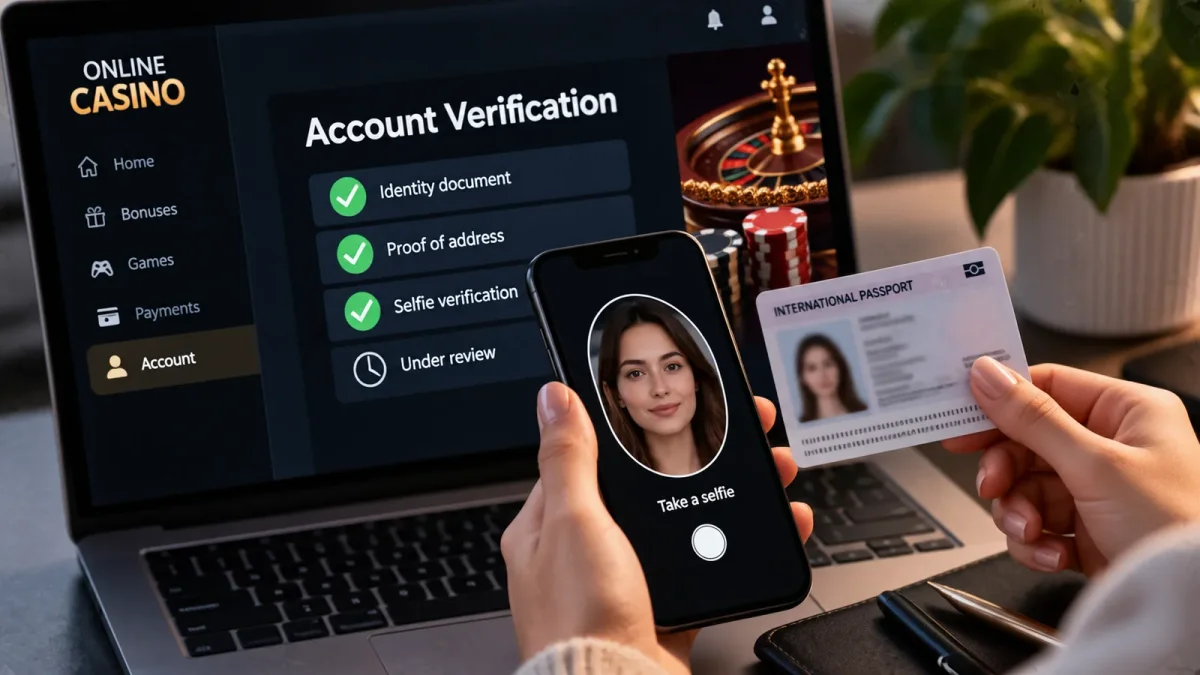
Casino KYC verification is the process an online casino uses to confirm that an account belongs to a real, eligible person and that the information, payments and activity attached to it can be legitimately connected to that person. Depending on the operator and jurisdiction, the check can involve electronic database matching, a passport or national ID, proof of address, a selfie or liveness scan, payment-method ownership and, in higher-risk cases, source-of-funds evidence.
The biggest misconception is that casino KYC verification always happens when a player makes a first withdrawal. It does not. Some regulated markets require core identity checks before gambling or even before the account is fully activated, while other operators perform lighter registration checks first and request documents later when automated verification fails or another compliance trigger appears. A withdrawal can trigger additional verification, but “KYC at withdrawal” is not a universal global rule.
The practical goal of this guide is to explain how to verify an online casino account without confusing routine identity checks with deeper AML reviews. It also covers the casino verification documents most commonly requested, why casino verification failed in typical cases, what a casino asking for ID is actually checking and when KYC casino withdrawal delays deserve closer scrutiny.
What Is Casino KYC Verification?
Casino KYC verification means “Know Your Customer” verification – a collection of identity and due-diligence checks used by regulated gambling operators to establish who controls an account. The process can support age verification, fraud prevention, anti-money-laundering controls, self-exclusion enforcement, payment ownership checks and compliance with market-specific licensing rules.
Casino KYC verification is therefore broader than simply uploading a passport. A casino may already have confirmed basic identity electronically without requesting any file at all, then later need a separate document because an address cannot be matched, a payment method changes or activity triggers enhanced due diligence.
| KYC Check | What It Usually Confirms | Common Evidence |
|---|---|---|
| Identity | Account belongs to the named person | Passport, national ID, driving licence |
| Age | Account holder meets legal age requirement | Government-issued ID, electronic database |
| Address | Registered residence is correct | Utility bill, bank statement, government document |
| Selfie / Liveness | Person submitting ID is its genuine holder | Live camera scan, selfie, video verification |
| Payment Ownership | Deposit or withdrawal method belongs to account holder | Card record, bank account, e-wallet details |
| Location / Eligibility | Account can legally use the service in the relevant market | Address, geolocation, local verification data |
| Source of Funds | Where money used for gambling originated | Bank statements, payslips, sale documents |
| Source of Wealth | Broader origin of a person's accumulated wealth | Employment, business, investment or asset evidence |
| Account Activity | Transactions are consistent with known account information | Deposit, withdrawal and wagering history |
Not every account goes through every row in the table. Casino KYC verification is usually risk-based and jurisdiction-specific, so a routine identity check can be much simpler than an enhanced AML review.
How to Verify an Online Casino Account
To verify an online casino account, first make sure the registration details exactly match the legal information on the documents that may later be submitted. Then use the casino's official verification area to complete any electronic check, upload the requested files and respond only to the specific verification request shown for the account.
A typical casino KYC verification process looks like this:
- Enter Accurate Registration Details. Use the legal name, date of birth and current address that appear on official records.
- Complete Electronic Verification. The casino may be able to match identity information automatically without requiring documents.
- Upload Proof Of Identity If Requested. Submit an accepted government-issued document through the casino's secure verification channel.
- Provide Proof Of Address If Needed. Use a recent document showing the same name and residential address as the account.
- Confirm Payment Ownership. The operator may need evidence that a card, bank account or e-wallet belongs to the account holder.
- Complete Selfie Or Liveness Verification. Some casino KYC verification systems compare a live image with the identity document.
- Respond To Additional Compliance Checks. Source-of-funds or other documents may be requested if account activity creates a legitimate regulatory need.
- Check The Verification Status. Confirm whether each submitted document has been accepted, rejected or sent for manual review.
The process can end after Step 2 when electronic casino KYC verification succeeds. At another operator, the same account information may need manual documents because available databases, local rules and verification technology differ.
Which Casino Verification Documents Are Usually Required?
The most common casino verification documents are proof of identity, proof of address and evidence of payment ownership. A selfie or liveness check is also increasingly common, while source-of-funds documents are usually associated with a deeper compliance review rather than every basic account verification.
| Document Type | Common Examples | What Casino KYC Verification Checks |
|---|---|---|
| Proof of Identity | Passport, national ID, driving licence | Name, photo, date of birth, document validity |
| Proof of Address | Utility bill, bank statement, official correspondence | Current residential address |
| Selfie / Liveness | Live camera capture, selfie with ID | Person matches submitted identity |
| Bank Ownership | Bank statement or account verification | Account is held in the player's name |
| Card Ownership | Approved masked card evidence where requested | Funding card belongs to account holder |
| E-Wallet Ownership | Account/profile evidence | Wallet belongs to registered player |
| Source of Funds | Payslip, bank record, sale/investment evidence | Origin of money used for gambling |
| Source of Wealth | Wider financial documents | How broader wealth was accumulated |
The casino should explain which document category is required rather than asking for an arbitrary collection of personal files. Submitting more casino verification documents than requested does not necessarily make casino KYC verification faster and can create unnecessary exposure of sensitive information.
Proof of Identity
Proof of identity establishes that the person behind the casino account matches the legal identity provided at registration. Passports, national identity cards and driving licences are among the most common documents, although accepted options vary by country and operator.
For casino KYC verification to succeed, the document generally needs to be valid, legible and complete. The legal name and date of birth should match the casino account, the photograph must be visible and security information must not be obscured where the verification system needs to read it.
Common identity-document problems include expired ID, cropped edges, glare over the photograph or machine-readable zone, unreadable text and registration details that differ from the document. These issues can send an otherwise simple casino KYC verification request into manual review.
Proof of Address
Proof of address confirms that the residential address registered on the account can be connected to the person being verified. Casinos may accept bank statements, utility bills, government correspondence or other documents defined in their own verification policy.
The document normally needs to show the account holder's name, current address, issuer and document date. Exact age limits vary, so statements that are accepted by one operator may be too old for another.
Digital documents are not automatically invalid. Many modern casino KYC verification systems accept original PDF statements or digitally issued bills, but a screenshot of only one corner of a banking app may not show enough information to verify the address.
Selfie and Liveness Verification
A selfie check compares the person completing casino KYC verification with the photograph on the identity document. More advanced liveness systems use a camera sequence, facial movement or another automated method to confirm that the person is physically present rather than submitting a static image.
These checks can fail when lighting is poor, the camera cannot focus, the face is partly covered or the identity document photograph is too unclear for a reliable comparison. Repeatedly submitting the same failed image is unlikely to solve that problem; the useful step is to identify whether the rejection concerns image quality, facial matching or the underlying document.
Selfie requests should be completed only through a verified casino domain and its authorised verification workflow. A message asking for sensitive identity files through an unexplained personal account or unrelated upload service deserves additional scrutiny before anything is sent.
Payment Method Verification
Payment verification establishes that the funding or withdrawal method is legitimately connected to the casino account holder. This is one reason using somebody else's card, bank account or e-wallet can create substantial problems even when the deposit itself initially goes through.
The exact evidence depends on the payment rail. Casino KYC verification may involve confirmation of the account holder's name, a bank account record, e-wallet profile information or another secure proof requested by the operator. Sensitive credentials such as online banking passwords or a card PIN should never be required as ordinary casino verification documents.
For more detail on why payment routes can behave differently at deposit and cashout, Casino Critic's casino payment guides cover cards, bank transfers, e-wallets and other rails separately.
Why Casinos Ask for ID
A casino asking for ID is not automatically evidence that something has gone wrong. Depending on the regulatory framework, ID can be required to verify age and identity, confirm eligibility for the gambling market, enforce self-exclusion controls or satisfy fraud and anti-money-laundering obligations.
In Great Britain, for example, online gambling businesses must verify core age and identity information before permitting gambling. New Jersey's internet gaming framework also requires identity authentication as part of account creation, while Ontario states that basic personal information goes through verification before the player account can be created.
This illustrates an important global distinction: casino KYC verification can be an account-opening requirement, not merely a withdrawal obstacle. A casino asking for ID should therefore be judged by whether the request is legitimate, proportionate and consistent with the rules governing that account, not simply by the fact that ID has been requested.
When Does Casino KYC Verification Happen?
Casino KYC verification can happen at registration, before gambling, before deposits, after automated verification fails, when a payment method changes, during an AML review or when a withdrawal requires information that has not already been established. There is no single worldwide trigger.
| Stage | Why Verification May Occur |
|---|---|
| Registration | Identity and age must be confirmed under local rules |
| Before Deposit | Some markets require authentication before account activity |
| Before Gambling | Core KYC may be mandatory before play |
| Payment Change | New card, bank account or wallet needs ownership verification |
| Withdrawal | Unresolved identity/payment issue or legitimate additional check |
| Unusual Transaction | Fraud or AML monitoring triggers deeper review |
| Higher-Risk Activity | Enhanced due diligence may be required |
| Account Detail Change | Name, address or other critical data has changed |
| Reverification | Existing information may no longer be reliable or current |
A first withdrawal is a common moment for casino KYC verification at some international operators because money is leaving the platform, but it should not be described as the universal point when KYC begins.
Casino KYC Verification Rules Differ by Market
Global casino KYC verification is not governed by one regulator. Markets set different rules for when identity must be confirmed and what operators must do before allowing deposits, gambling or account access.
| Market | Core Verification Approach | Important Detail |
|---|---|---|
| Great Britain | Core identity verified before gambling | Operators should request additional information promptly rather than unnecessarily waiting for withdrawal |
| New Jersey | Multi-source identity authentication forms part of internet gaming account creation | Key data and the person creating the account must be authenticated before patron-initiated activity |
| Ontario | Identity information is verified as part of player account creation | Player must also be physically located in Ontario to gamble on regulated sites |
| Malta | Player registration and KYC procedures form part of operator compliance controls | Operators maintain verification status and due-diligence records under applicable requirements |
| Other Markets | Timing and required evidence depend on local licensing and AML rules | Never assume another country's KYC timing applies automatically |
This is why a global article should not say that every licensed casino performs casino KYC verification in exactly the same way. The correct benchmark is the regulatory framework covering the actual account.
How Long Does Casino KYC Verification Take?
Casino KYC verification can be nearly instant when an electronic system successfully matches the account information, while document-based or manual reviews can take considerably longer. There is no reliable universal timeframe that applies to every casino, document type or market.
The UK Gambling Commission explicitly notes that it cannot provide one fixed timescale because electronic verification may happen instantly while document checks take longer. That distinction applies more broadly: a clear passport processed automatically is a very different workflow from a source-of-funds case requiring review by a compliance team.
| Type of Check | Why It Can Be Faster or Slower |
|---|---|
| Electronic identity match | Can complete quickly when database information matches |
| ID document scan | Depends on image quality and automated reading |
| Proof of address | Can require manual review if details do not match |
| Selfie / liveness | May complete quickly or fail into manual review |
| Payment ownership | Depends on payment method and available evidence |
| Source of funds | Usually more complex because context and financial documents need assessment |
| Reverification | Can be simple or extensive depending on the trigger |
| Failed documents | Each rejection and resubmission adds another review cycle |
A casino advertising “instant KYC” should therefore be understood carefully. The technology may support instant casino KYC verification for straightforward cases, but no legitimate operator can guarantee that every account will pass every compliance check instantly.
Why Casino Verification Failed
When casino verification failed, the cause is usually either document quality, mismatched account information, an unsupported document or insufficient evidence for the specific check being performed. The fastest fix is to identify exactly which requirement failed rather than uploading several versions at random.
| Reason for Rejection | What Went Wrong | What to Check |
|---|---|---|
| Blurry image | Text or security details cannot be read | Retake in focus |
| Cropped document | Important edges or information are missing | Show complete document |
| Glare / reflection | Data or photograph is obscured | Change lighting |
| Expired ID | Document is no longer valid | Submit current ID |
| Name mismatch | Casino account and document differ | Check legal name |
| Address mismatch | Account and proof of address do not match | Verify current registration details |
| Old address document | Outside operator's accepted date range | Use a more recent document |
| Missing page / side | Required information is incomplete | Upload all requested parts |
| Screenshot rejected | Original PDF or document required | Follow requested format |
| Unsupported document | Operator does not accept that document type | Choose an approved alternative |
| Payment not in player's name | Ownership cannot be established | Resolve third-party payment issue |
| Failed selfie | Facial match or liveness could not be confirmed | Retake under correct conditions |
| Edited image | Verification system detects modification | Upload original evidence |
| Incorrect file | Document proves the wrong category | Check exact request |
Most importantly, do not assume that every rejection means the casino is intentionally delaying casino KYC verification. A bad photograph is a genuine technical problem; repeated unexplained rejections of compliant documents are a different issue and should be treated accordingly.
Blurry or Cropped Casino Verification Documents
Blurry and cropped images are among the most avoidable causes of failed casino KYC verification. Automated document systems need enough resolution to read names, dates, numbers and security features, while manual reviewers also need to see that the entire document appears genuine.
Place the document on a flat surface, use even lighting and keep all requested edges visible. Do not cover information unless the casino's own instructions specifically permit or require masking particular payment details.
If the original document is digital, use the original PDF when that format is accepted rather than taking a low-resolution screenshot. The goal is not to make casino verification documents visually attractive – it is to make every required field unambiguous.
Name Mismatch During Casino KYC Verification
Name mismatches can happen when an account was registered using a nickname, abbreviated surname, missing middle name, previous surname or spelling that differs from the official document. Automated verification is particularly sensitive to differences in key identity fields.
The correct response depends on the mismatch. A simple typo may be resolved through an account-data correction process, while a legal name change may require evidence connecting the old and new names. Opening another account under different details is generally not an appropriate workaround and can create duplicate-account problems.
Casino KYC verification works most smoothly when registration begins with the full legal information that can later be supported by official records.
Address Mismatch During Casino Verification
Address verification often fails because a player moved but updated only one side of the record. The casino account might show the new address while the submitted bank statement still shows the old one, or the opposite can occur.
Formatting differences are not always fatal, but the underlying address must be logically consistent. An apartment number, postcode or street number that conflicts with the account can require clarification.
Before uploading proof of address, compare it line by line with the registration details. That simple check can prevent an otherwise avoidable manual casino KYC verification review.
Expired ID and Old Documents
An expired passport or identity card may no longer satisfy the operator's verification rules even if the photograph and personal details remain accurate. Proof-of-address documents can also become unacceptable when they are older than the period defined in the casino's KYC policy.
There is no need to assume one universal “90-day rule” across every casino. Many operators use recent statements or bills, but accepted document age is an operator- and jurisdiction-specific condition.
The correct document is therefore the one that meets the current casino KYC verification instructions shown for that account, not whichever file worked at another casino.
Why Selfie Verification Fails
Selfie or liveness verification can fail because the camera image is dark, blurred, overexposed or inconsistent with the ID photo. Glasses, head position, camera permission problems or an old identity photograph can also complicate automated facial matching.
Follow the on-screen sequence exactly and avoid uploading a pre-edited photograph when a live capture is requested. If several attempts fail, continuing the same process indefinitely is less useful than asking whether manual verification is available.
A failed liveness check does not automatically mean the entire account has failed casino KYC verification. It can simply mean that one verification method needs another attempt or manual review.
What Is Source-of-Funds Verification?
Source-of-funds verification asks where the money being used for gambling came from. It is a deeper compliance check than ordinary proof of identity and can be triggered when an operator needs additional information to understand the financial activity attached to an account.
Possible evidence depends on the actual source and may include salary records, bank statements, proceeds from an asset sale, investment documentation or other material capable of explaining the funds. The document should match the source being claimed rather than merely showing that money exists in an account.
Source-of-funds review should not be confused with routine casino KYC verification. A passport proves identity; it does not explain where a significant financial transaction originated.
Source of Funds vs Source of Wealth
Source of funds concerns the origin of the particular money connected to transactions, while source of wealth looks more broadly at how a person's overall financial position was accumulated. The two concepts can overlap but answer different questions.
| Check | Core Question | Possible Evidence |
|---|---|---|
| Source of Funds | Where did the money used for these transactions come from? | Salary payment, bank history, asset sale, investment proceeds |
| Source of Wealth | How was the person's broader wealth accumulated? | Employment history, business ownership, investments, inheritance, assets |
Not every player undergoing casino KYC verification will ever face either check. These are risk-based compliance processes rather than standard casino verification documents automatically required from every account.
Why a Casino May Ask for Bank Statements
A bank statement can serve several different purposes, so the reason for the request matters. It can verify an address, show ownership of a bank account, confirm a transaction or support a source-of-funds assessment.
That means “the casino asked for a bank statement” does not reveal enough by itself. A legitimate request should make it reasonably clear what information is needed and why that category of evidence is relevant.
Where redaction is permitted, follow the operator's instructions rather than guessing which details can be hidden. Over-redacting can make casino KYC verification impossible, while sending unrelated financial information exposes more data than necessary.
Does KYC Mean the Casino Thinks You Are Laundering Money?
No. Routine casino KYC verification does not mean an operator suspects a particular player of money laundering. Basic identity verification is a normal regulatory requirement in many gambling markets and is performed on large numbers of ordinary accounts.
AML monitoring becomes more specific when unusual transactions, third-party payment methods, significant changes in activity or other risk indicators require enhanced review. The UK Gambling Commission's 2026 remote-casino risk assessment, for example, identifies third-party payment methods, multiple payment methods, unusual wagering patterns and certain source-of-income concerns among relevant money-laundering risks.
The distinction is important: KYC establishes who the customer is; AML monitoring assesses whether financial activity requires further investigation. The two systems interact, but they are not identical.
Why Casino KYC Verification Can Affect a Withdrawal
A withdrawal can be paused when the operator legitimately needs information that has not yet been verified or when the transaction itself creates a new compliance issue. Payment ownership, changed account details, an unresolved document request or enhanced AML review can all affect KYC casino withdrawal processing.
This does not mean that every withdrawal should automatically trigger a fresh passport request. In Great Britain, operators are specifically told not to wait until withdrawal to request identity information they could reasonably have requested earlier, although new legal or AML obligations can still justify additional questions later.
This distinction is central to evaluating casino KYC verification fairly. A genuine new compliance need is different from repeatedly postponing routine identity checks until money is being withdrawn.
What to Do When KYC Blocks a Casino Withdrawal
If KYC casino withdrawal processing stops, first determine whether the withdrawal itself is pending or whether the entire account has an unresolved verification status. Then identify the exact document or compliance issue rather than repeatedly asking when the money will arrive.
Use this sequence:
- Check The Verification Dashboard. Look for pending, rejected or additional-document statuses.
- Read The Exact Request. Determine whether the issue is identity, address, payment ownership or a deeper financial check.
- Confirm Account Details. Compare name, address and date of birth against the requested evidence.
- Resubmit Only Corrected Documents. Do not upload the same rejected file without fixing the stated problem.
- Ask Which Verification Stage Is Outstanding. Request a specific answer rather than a generic withdrawal estimate.
- Save All Correspondence. Keep document-status messages, dates, transaction IDs and support responses.
- Use The Formal Complaint Route If Necessary. Escalate when compliant documents remain unresolved beyond the operator's published process without a clear explanation.
The Casino Critic review methodology treats KYC and payout transparency as separate review factors for this reason. A casino can legitimately conduct verification while still handling communication or withdrawal timing poorly.
Can a Casino Ask for ID After You Already Verified?
Yes. Casino KYC verification is not necessarily a one-time event that can never be revisited. Reverification can be legitimate if key account information changes, the original document expires, payment methods change, data appears compromised or a new regulatory or AML concern arises.
The question is whether the new request has a reasonable connection to the account situation. A player who completed identity verification years ago can still need updated information, particularly when old address or identity records are no longer current.
What should be avoided is assuming that a “verified” badge creates permanent immunity from all future compliance checks. Verification confirms information at a point in time; some information can later change or require deeper validation.
Can a Casino Ask for ID Every Time You Withdraw?
Routine repeated identity checks on every withdrawal are not a universal regulatory requirement. A casino may need transaction-specific verification in particular circumstances, but repeatedly requesting identical documents without explaining what new issue exists is different from a normal casino KYC verification workflow.
If the same valid passport has already been accepted and the account information has not changed, ask what additional requirement the new request is intended to satisfy. The answer may involve payment ownership, AML review or another specific check rather than basic identity.
Clear operators distinguish these processes instead of labelling every compliance action simply as “KYC”.
Can a Casino Refuse a Withdrawal Until KYC Is Complete?
A casino can delay a withdrawal when legitimate verification or legal checks remain unresolved, but the exact powers and obligations depend on the licence and jurisdiction. An operator still needs to handle the customer's funds according to the rules governing that account and should explain what information is outstanding.
Refusing to provide genuinely required casino verification documents can prevent the operator from completing its compliance obligations. That is different from a situation where all requested evidence has been provided and the casino repeatedly changes requirements without giving a clear reason.
For a broader explanation of the difference between casino processing, verification and payment settlement, Casino Critic's casino payment guides explain why a withdrawal can be delayed at several different stages.
What Does “No KYC Casino” Really Mean?
“No KYC” usually requires careful reading. It can mean less upfront casino KYC verification, automated verification without document upload or an operator that does not routinely request documents at registration – not necessarily a permanent guarantee that identity will never be checked.
A casino can still reserve the right to request verification when account activity, withdrawal size, payment ownership, fraud monitoring or applicable compliance rules require it. Crypto deposits do not automatically remove those obligations.
This is why “no documents at signup” and “no KYC under any circumstances” should not be treated as equivalent claims. The relevant terms are the actual verification triggers written into the operator's rules and licence framework.
Does Crypto Avoid Casino KYC Verification?
Not necessarily. Cryptocurrency changes the payment rail; it does not automatically remove identity, fraud or AML requirements attached to the casino account.
A crypto casino can permit wallet-based deposits while still requesting casino KYC verification before certain withdrawals, after risk triggers or under the requirements of its licensing and compliance framework. Wallet ownership can also become part of a verification process.
Crypto therefore affects how money moves, not whether every operator can legally ignore who controls the account. Claims of complete anonymity should be checked against the casino's actual terms rather than inferred from the presence of Bitcoin or another cryptocurrency.
Is Casino KYC Verification Safe?
Casino KYC verification involves sensitive personal information, so the safety of the upload route matters. Before sending an identity document, verify that the casino domain is genuine, that the operator is licensed where relevant and that documents are being submitted through an authorised verification system.
A legitimate casino KYC verification process may need detailed information, but ordinary verification should never require sharing a banking password, card PIN or password to an e-wallet account. Those credentials authenticate access to the financial service itself and are different from evidence proving account ownership.
| Normal Verification Request | Suspicious Request |
|---|---|
| Upload ID through secure casino verification portal | Send banking password in chat |
| Complete live selfie through recognised workflow | Send documents to unrelated personal account |
| Provide approved proof of address | Reveal card PIN |
| Confirm bank/e-wallet ownership | Hand over e-wallet password |
| Provide specific source-of-funds evidence where legitimately required | Pay an extra “KYC fee” to release money |
| Correct rejected document through official account | Upload ID to an unexplained third-party link |
The distinction is not that sensitive documents are never legitimate. It is that casino KYC verification should use an identifiable purpose and a secure, verifiable route.
Can You Cover Parts of a Card During Verification?
Only follow the casino's specific instructions. Some payment-verification processes permit or require sensitive portions of a card number to be obscured while leaving enough information visible to establish ownership, but the accepted format varies.
Never assume that every casino wants the same masking pattern. Uploading an over-redacted image can cause casino KYC verification to fail, while exposing unnecessary card data is equally undesirable.
CVV security codes and PINs should not form part of ordinary proof-of-ownership requests. If instructions are unclear, ask the verification team what information must remain visible before uploading the image.
Should You Send KYC Documents by Email?
Use the casino's secure verification portal whenever one is provided. Email may sometimes be an operator-approved route, but it should not be assumed to be the preferred or safest channel when a dedicated encrypted upload system exists.
Before responding to an email request for casino verification documents, confirm that the message genuinely came from the operator and that the requested submission route matches information available inside the logged-in account.
Phishing becomes particularly dangerous in casino KYC verification because passports, proof of address and payment information can be valuable outside gambling. Verification should begin with verifying the casino itself.
How to Make Casino KYC Verification Faster
There is no legitimate trick that guarantees instant casino KYC verification, but preventable errors can be removed. Accurate registration data and clean documents usually matter more than uploading a large volume of evidence.
Before submitting documents:
- Match The Legal Name Exactly. Do not use a nickname if official ID shows something different.
- Check The Address. Make sure the account and proof-of-address document refer to the same current residence.
- Use Valid Documents. Avoid expired identity documents or statements outside the accepted date range.
- Show The Complete Document. Do not crop required edges or pages.
- Use Good Lighting. Remove glare and make all text readable.
- Follow The Requested Format. Upload PDF, photograph or live capture exactly as instructed.
- Verify Payment Ownership. Use payment methods belonging to the registered account holder.
- Answer The Actual Request. A bank statement cannot replace a passport when proof of identity is required.
These steps improve the chance that automated casino KYC verification can read the submission without moving it unnecessarily into manual review.
What Not to Do During Casino Verification
Trying to “fix” verification by editing documents can create a much larger problem than the original rejection. Do not alter dates, names, addresses or account information, and do not open another account merely because the first one is awaiting review.
Also avoid sending multiple contradictory documents without explanation. If one statement shows an old address and another shows a new one, tell the casino that the address changed rather than leaving the compliance team to infer why the records differ.
Casino KYC verification is designed to establish consistency. Creating more inconsistencies usually makes the process slower, not faster.
KYC Verification and Third-Party Payments
Third-party payments can create substantial verification friction because the casino account holder and funding-source owner are different people. A deposit made with a partner's card or another person's e-wallet may therefore require additional investigation or be prohibited under the operator's terms.
The issue is not simply whether permission was given privately. The operator needs to satisfy its own payment, fraud and AML requirements and may be unable to treat another person's financial account as belonging to the registered player.
Using payment methods in the account holder's own name makes ownership easier to establish and reduces one of the most common sources of additional casino KYC verification.
What If Your Address or Name Changed?
Legitimate personal details can change, and casino KYC verification should have a process for updating them. A move, marriage, divorce or formal name change can create mismatches between old account data and newer documents.
Do not silently overwrite critical information or submit documents that appear contradictory without context. Use the casino's account-update process and provide supporting evidence when it is legitimately needed.
Once the underlying record is corrected, future casino verification documents should be consistent with the updated details.
What if Casino KYC Verification Takes Too Long?
First compare the delay with the operator's own published verification process and determine whether the case is a routine document review or a more complex compliance investigation. There is no universal global rule saying every casino KYC verification must finish within a fixed number of hours.
If the stated timeframe has passed, request a specific status: Which document or check is pending? Has the case moved to manual review? Is additional evidence required? Has the verification itself been completed but the withdrawal remained pending for another reason?
Keep screenshots and written responses if the delay continues. The key warning sign is not simply that casino KYC verification takes time, but that the operator cannot explain what is outstanding while repeatedly moving the goalposts.
Casino KYC Verification vs Withdrawal Processing
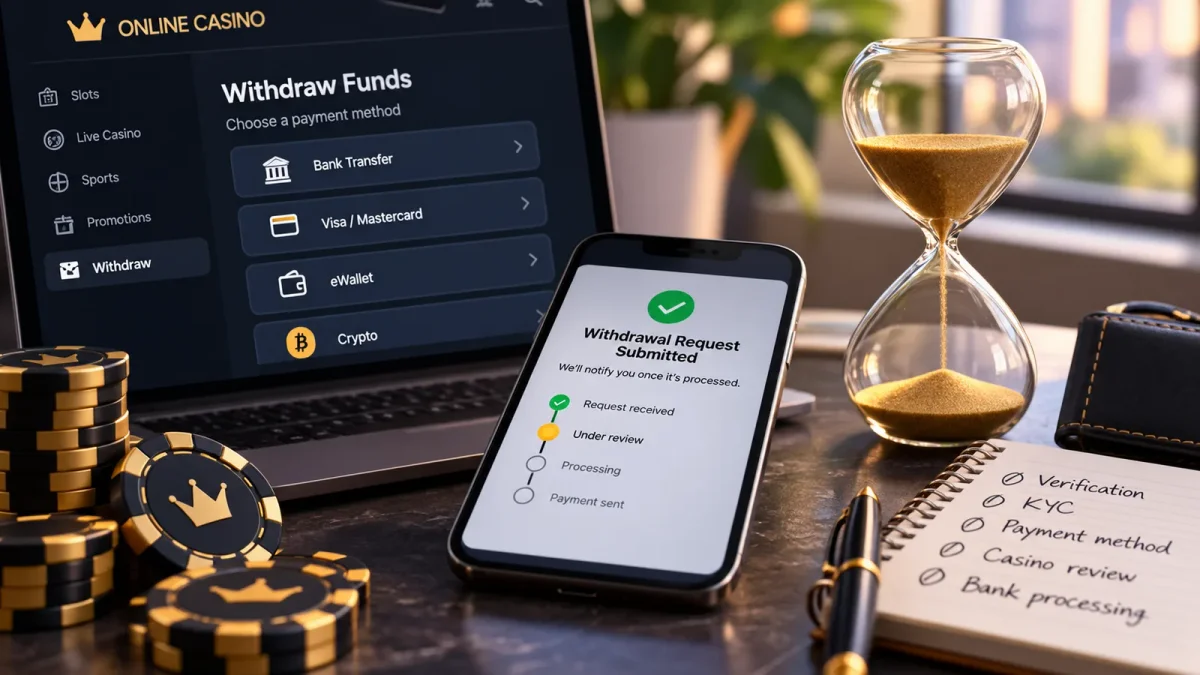
Verification time and withdrawal time should be measured separately. A casino can finish casino KYC verification today but still require additional internal time to approve the payment, after which a bank or e-wallet may need its own settlement period.
| Stage | Main Question |
|---|---|
| KYC Review | Has the account and requested evidence been verified? |
| Withdrawal Approval | Has the casino approved release of the money? |
| Payment Processing | Has the payment been sent through the chosen rail? |
| Settlement | Has the bank, wallet or network credited it? |
This distinction prevents a common mistake: blaming casino KYC verification for every delayed payout even after the account has already been marked verified.
When Casino Verification Becomes a Red Flag
A legitimate KYC request can be inconvenient without being suspicious. Red flags appear when the process lacks a clear regulatory or account purpose, sensitive information is requested through unsafe channels or the operator uses verification as a constantly changing barrier without explaining what remains unresolved.
Potential warning signs include:
- Licence information cannot be verified.
- The upload link does not belong to the casino or a clearly identified verification provider.
- Support asks for a bank password, card PIN or other authentication secret.
- A fee or additional deposit is required to “unlock KYC”.
- Documents are rejected repeatedly without identifying any problem.
- New requests appear one at a time after each previous document has been accepted, with no explanation of the underlying review.
- Support claims verification is complete but refuses to identify why the withdrawal remains blocked.
- The casino cannot provide a formal complaints process.
One rejected passport does not prove misconduct. A pattern of unexplained barriers is much more significant than an ordinary casino KYC verification request.
How Casino Critic Evaluates KYC
Casino KYC verification forms part of a broader operator assessment rather than being treated as automatically positive or negative. Casino Critic looks at whether the operator explains its verification process, when checks occur, how payment ownership is handled and whether withdrawal information remains transparent when additional compliance is required.
The wider Casino Critic review methodology also checks licensing, payments, bonus fairness and responsible-gambling tools. That matters because a fast KYC flow cannot compensate for an invalid licence or poor withdrawal policy, just as a strong licence does not make a confusing verification experience irrelevant.
| KYC Factor | What to Check |
|---|---|
| Timing | Is basic verification performed at the stage required by the market? |
| Transparency | Are possible document requests disclosed clearly? |
| Electronic Verification | Can straightforward accounts be verified without unnecessary friction? |
| Document Process | Are accepted formats and requirements explained? |
| Rejections | Does the operator state what failed? |
| Payment Ownership | Are rules clear before deposit/withdrawal? |
| Enhanced Checks | Are deeper requests connected to a legitimate compliance purpose? |
| Withdrawal Impact | Is KYC separated from other payout-processing stages? |
| Complaints | Is there an escalation route if verification becomes disputed? |
The objective is not to reward a casino for asking for fewer documents at all costs. Good casino KYC verification is proportionate, understandable and completed at the appropriate stage rather than used as an unexplained obstacle.
KYC and Responsible Gambling Checks Are Not the Same Thing
Casino KYC verification confirms identity and related account information, while responsible-gambling systems monitor whether behaviour suggests increasing risk of harm. The same account data can contribute to both processes, but their purposes are different.
For example, repeated cancelled withdrawals, sudden spending changes or failed deposits may matter to responsible-gambling monitoring even when identity has already been fully verified. Ontario's current guidance explicitly treats account behaviours such as failed deposits and cancelled withdrawals as indicators operators should consider when identifying potential harm.
Casino Critic's responsible gambling guide explains tools such as deposit limits, time-outs and self-exclusion separately because none of them should be confused with passing KYC.
Casino KYC Verification Checklist
Before uploading anything, check the request itself, the document and the submission route. Most failed verification attempts can be understood through those three areas.
| Check | Before You Submit |
|---|---|
| Casino Domain | Confirm the website is genuine and correctly licensed where applicable |
| Exact Request | Identify whether the casino needs ID, address, payment or financial evidence |
| Legal Name | Match registration and document details |
| Date of Birth | Confirm no registration error |
| Address | Use the same current address across account and proof |
| Document Validity | Check expiration and acceptable date range |
| Image Quality | Ensure text and photograph are readable |
| Full Document | Include all requested edges, sides or pages |
| File Format | Use the format specified by the casino |
| Payment Ownership | Make sure funding route belongs to the player where required |
| Secure Upload | Use the authorised verification portal |
| Status | Save acceptance/rejection messages |
Completing this checklist cannot guarantee that every account will pass automatically. It does eliminate many avoidable reasons for casino KYC verification to move from a simple automated check into a longer manual process.
Final Verdict – Good KYC Should Explain What Is Being Verified
Casino KYC verification is not simply a passport check performed before a withdrawal. It can include electronic identity matching, proof of address, payment ownership, biometric verification and, when legitimately required, source-of-funds or enhanced due-diligence checks.
The timing depends on the market and operator. Great Britain requires core age and identity verification before gambling, New Jersey incorporates authentication into internet gaming account creation, and Ontario verifies identity before the account is created. Other jurisdictions use their own rules, so “all casinos verify at first withdrawal” is not an accurate global description of casino KYC verification.
For the player, the most effective preparation is straightforward: register with accurate legal information, use payment methods in the same name, read the verification policy before depositing and submit only the specific casino verification documents requested through a secure channel. When casino verification failed, find the precise reason before resubmitting; when KYC delays a withdrawal, separate the verification stage from the casino's later payment processing.
A legitimate casino asking for ID should be able to explain what needs to be verified, what evidence is accepted and what remains outstanding. That transparency is just as important as the speed of the check.