Oliver Rodriguez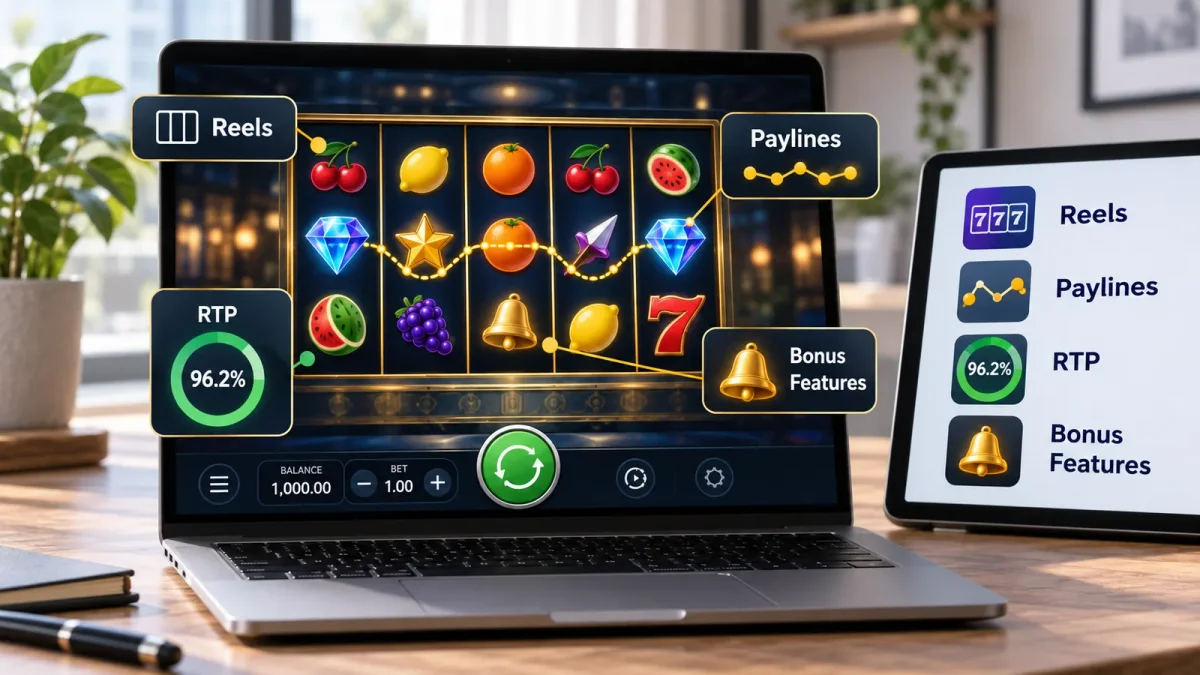
Learning how to play online slots starts with four basic actions: choose a game, check its rules, set the stake and press Spin. Matching symbols then need to form a valid combination under that slot's pay system, whether it uses fixed paylines, ways to win, clusters or another mechanic. Every real-money spin puts the selected stake at risk, and no betting pattern can guarantee a wi ing result.
That simple description hides much of what actually matters. Modern online slots can have three reels or eight, fixed paylines or hundreds of thousands of possible ways, cascading symbols, multipliers, free spins, jackpots and feature buys. Before playing a slot, the useful information is not the theme on the loading screen but how wins are formed, the RTP, volatility, stake range, bonus rules and maximum payout.
This guide explains how to play slots from the ground up for a global audience. Feature availability, casino regulation and specific gambling controls vary by country, so the exact game version and local rules should always be checked before real-money play.
How to Play Online Slots in 6 Steps
To play online slots, open a game, read its information screen, select a stake and spin the reels. If the resulting symbols satisfy the game's pay rules, the corresponding payout is credited automatically.
The full process for a first slot can be reduced to six steps:
- Choose The Slot. Check the provider, reel layout, RTP, volatility, maximum win and available features before playing.
- Open The Paytable. Confirm which symbols pay, how wins are formed and what triggers free spins or other bonuses.
- Set The Stake. Choose the total amount that will be risked on each spin and verify the displayed figure before starting.
- Press Spin. The game generates a result independently for that round and displays it on the reels.
- Check The Result. Wi ing paylines, ways or clusters are usually highlighted automatically, together with the payout.
- Stop Within The Pla ed Limit. Increasing stakes or continuing after losses does not make a future wi ing spin more likely.
Those six steps work across most online slots, even when the underlying mechanics look completely different. The important part is understanding what the slot counts as a win before putting money into it.
How Do Online Slot Machines Work?
Online slot machines are software-based casino games in which each paid spin produces a randomised outcome and pays according to a predetermined set of rules. The graphics show spi ing reels, but the visual animation is essentially the presentation layer for the underlying game mathematics.
A slot normally combines several elements at once: reels, rows, symbols, a pay system, a paytable, a stake and an RNG-generated result. Modern games then add layers such as Wilds, Scatters, multipliers, cascading wins or bonus rounds.
| Slot Element | What It Does |
|---|---|
| Reels | Vertical columns containing symbols |
| Rows | Horizontal symbol positions visible on the grid |
| Symbols | Icons used to create wi ing combinations or trigger features |
| Paylines / Ways | Rules defining where matching symbols must land |
| Paytable | Lists payouts, symbols and feature rules |
| Stake | Amount risked on one spin |
| RTP | Theoretical long-term percentage returned through payouts |
| Volatility | Describes how unevenly payouts tend to be distributed |
| RNG | Generates independent game outcomes |
| Bonus Features | Free spins, multipliers, respins, Wilds and other mechanics |
The layout alone does not tell you how a slot pays. Two games can both use five reels and three rows while one has 10 fixed paylines and the other uses hundreds of ways to win.
What Are Reels and Rows?
Reels are the vertical columns that display the symbols, while rows describe the horizontal positions visible when those reels stop. A traditional slot may use 3 reels × 3 rows, while modern video slots commonly use 5 reels with three, four or more rows.
Three-reel layouts remain relevant in 2026 because they offer a much simpler visual structure than large video-slot grids. Examples of how the format has evolved are covered in Casino Critic's guide to 3-reel slots in 2026, where classic-looking grids can still include modern Hold & Win features, jackpots and other bonus mechanics.
More reels do not automatically mean better odds, higher RTP or a larger payout. The game's mathematical model matters more than the physical size of the grid.
What Are Paylines in Slots?
A payline is a predefined pattern across the reels on which matching symbols can form a wi ing combination. Depending on the slot, there might be one line, 10, 20, 50 or considerably more.
A simple five-reel slot might require matching symbols to appear from left to right across adjacent reels. For example, if three matching symbols land on the first three reels along an active payline, the paytable determines whether that combination pays and how much.
| Pay System | How A Win Is Formed | Typical Structure |
|---|---|---|
| Fixed Paylines | Symbols land on predefined lines | 5×3 video slots |
| Adjustable Paylines | Player selects how many lines are active | Older multi-line slots |
| Ways To Win | Matching symbols appear on adjacent reels | 243, 1,024 or more ways |
| Megaways | Number of symbols changes on each reel | Up to hundreds of thousands of ways |
| Cluster Pays | Groups of matching symbols touch each other | Grid-based slots |
| Pays Anywhere | Required number of matching symbols land anywhere | Tumble / scatter-pay games |
A payline is therefore only one way to build an online slot. Many of the most prominent modern games do not use traditional paylines at all.
How Do Ways-to-Win Slots Work?
Ways-to-win slots remove fixed line patterns and instead pay when enough matching symbols appear on consecutive reels in eligible positions. A standard six-reel game might offer hundreds or thousands of combinations because each reel can contribute multiple matching symbols to the same win.
The important distinction is that symbols usually do not need to sit on the same horizontal or diagonal line. If matching symbols appear on the required adjacent reels, their positions can often vary vertically.
This makes the screen look less restrictive than a fixed-payline game, but it does not mean the slot is mathematically more generous. More possible combinations do not automatically produce a higher RTP.
What Is Megaways?
Megaways is a variable-reel mechanic in which the number of symbols visible on individual reels can change from spin to spin. Because the reel heights can vary, the number of possible wi ing combinations can also change on every round.
The precise maximum depends on the game configuration. Some Megaways titles also combine changing reel sizes with cascading wins, multipliers or free-spin features. A practical example can be seen in Casino Critic's 5 Lions Megaways review, which breaks down how the variable-reel system interacts with free-spin configurations and the game's published mathematics.
Megaways should be treated as a method of arranging possible combinations, not a guarantee of frequent or larger payouts. RTP and volatility still determine the broader mathematical profile.
What Are Cluster-Pay Slots?
Cluster-pay slots award wins when enough identical symbols form a co ected group, usually horizontally or vertically. Instead of tracing a line across separate reels, the game checks the grid for clusters that satisfy its minimum size.
These games often use larger boards such as 7×7 or similar grid layouts and frequently combine cluster wins with cascading symbols. After one wi ing cluster disappears, new symbols can drop into the vacant positions and potentially create another result without starting a completely new paid spin.
The mechanic changes the visual structure of play, but the same core principle remains: the paytable defines exactly what qualifies as a win.
What Is an RNG in Online Slots?
An RNG, or Random Number Generator, is the system used to determine the outcome of each spin. The result of one properly functioning random slot spin is independent of whether the previous round won or lost.
This means a slot is not “due” because it has gone through a long losing sequence, and a large payout does not make the next spin inherently less likely to win. Historical results can describe what has already happened, but they do not provide a pattern that guarantees what comes next.
Casino Critic expert take: The most important thing to understand before learning any slot “strategy” is that previous spins do not create a debt the game has to repay. A long losing run does not make the next spin more likely to produce a jackpot.
Regulated game versions are expected to meet the testing and technical standards applicable in their licensed markets. Casino Critic's review methodology checks game providers, published RTP information and operator licensing as separate parts of casino assessment rather than treating the presence of popular slots as proof that an operator itself is trustworthy.
How to Read a Slot Paytable
The paytable is the most useful screen to open before learning how to play a particular online slot. It explains what pays, which symbols have special functions and how bonus rounds are triggered.
A useful paytable should answer several questions before the first real-money spin:
- Which symbols have the highest payouts?
- How many matching symbols are required?
- Do wins start from the leftmost reel?
- Are paylines, ways or clusters used?
- Which symbol acts as the Wild?
- What does the Scatter trigger?
- How many free spins can be awarded?
- Can features be retriggered?
- What is the maximum payout?
- What stake range is available?
After reading the paytable, it should be possible to explain in one sentence how a normal win is formed and how the main bonus feature begins. If either remains unclear, the game's rules need another look before any stake is placed.
What Are Slot Symbols?
Slot symbols are the icons that determine ordinary payouts or activate special mechanics. Their exact functions vary by title, so even familiar labels such as Wild or Scatter should not be assumed to behave identically in every game.
| Symbol Type | Typical Function |
|---|---|
| Standard Symbol | Creates ordinary paid combinations |
| High-Value Symbol | Pays more than lower-value symbols |
| Wild | Substitutes for selected regular symbols |
| Expanding Wild | Expands across part or all of a reel |
| Sticky Wild | Remains in place for multiple spins or respins |
| Multiplier Wild | Substitutes and multiplies a qualifying payout |
| Scatter | Often triggers free spins or another bonus |
| Bonus Symbol | Activates a specific feature |
| Collect Symbol | Collects cash values or other special symbols |
| Jackpot Symbol | Can contribute toward a fixed or progressive jackpot |
These are conventions rather than universal rules. A Wild might substitute for every normal symbol in one slot but exclude Scatters, bonus symbols or special collector icons in another.
How Do Wild Symbols Work?
A Wild usually substitutes for one or more standard symbols to help form a valid combination. Depending on the slot, Wilds can also carry multipliers, expand across reels, move between spins or remain sticky during a feature.
Suppose a payline contains:
A – A – Wild – A – K
If the Wild substitutes for A and the slot pays for four matching A symbols from the first reel, the combination can qualify as a four-of-a-kind result.
That example ca ot be generalised to every game because the paytable determines which symbols a Wild may replace and how the resulting payout is calculated.
What Are Scatter Symbols?
Scatter symbols commonly trigger free spins or bonus rounds when a required number appear on the grid. Unlike traditional payline symbols, Scatters often do not need to sit on a particular payline.
Three Scatters might award free spins in one slot, while another could require four or use different Scatter counts to award different numbers of spins. Some titles also pay an immediate Scatter prize separately from the bonus trigger.
Never assume that three Scatters automatically mean free spins. The game information screen gives the actual trigger condition.
What Does RTP Mean in Slots?
RTP stands for Return to Player and represents a slot's theoretical long-term return through payouts as a percentage of total stakes. A slot configured at 96% RTP therefore has a theoretical house edge of 4%.
The basic relationship is:
House edge = 100% – RTP
So:
- 94% RTP = 6% theoretical house edge.
- 95% RTP = 5% theoretical house edge.
- 96% RTP = 4% theoretical house edge.
- 97% RTP = 3% theoretical house edge.
The key word is theoretical. A 96% RTP does not mean that someone who wagers $100 will receive $96 back during that session, and it does not mean every block of 100 spins will behave similarly. RTP is a long-run mathematical property that becomes meaningful over a much larger number of rounds than one individual session.
Why the RTP Inside the Game Matters
The RTP shown for the exact game version being played is more useful than assuming every casino runs the provider's headline configuration. Some slot developers make more than one approved RTP version available to operators or regulated markets.
For that reason, check the Info, Help or Paytable screen inside the actual slot where RTP is disclosed. An external review can explain the game's typical configuration, but the deployed version is the relevant figure for the session in front of you.
This matters particularly when comparing the same title across different casinos. The artwork and mechanics can look identical while the configured theoretical return differs.
What Is Slot Volatility?
Slot volatility describes how payouts tend to be distributed rather than how much the game theoretically returns. Low-volatility slots generally concentrate more of their return into smaller, more frequent payouts, while high-volatility games tend to produce more uneven results with greater potential for extended losing sequences and less frequent larger wins.
| Volatility | Typical Payout Pattern | Balance Movement |
|---|---|---|
| Low | More frequent, generally smaller wins | Usually less uneven |
| Medium | Mix of smaller and larger payouts | Moderate swings |
| High | Less frequent, potentially larger payouts | Greater short-term swings |
Volatility and RTP are not the same measurement. A low-volatility slot can have a lower RTP than a high-volatility game, and two slots can both have 96% RTP while producing completely different short-term experiences.
Lower volatility does not remove gambling risk, and higher volatility does not mean the game is mathematically more rewarding.
What Is Hit Frequency?
Hit frequency describes how often a slot is mathematically expected to produce a qualifying wi ing outcome, usually expressed as a percentage. If a game publishes a 25% hit frequency, that does not guarantee exactly one win every four spins.
The figure describes a theoretical distribution over many rounds. Wins can cluster together or long stretches can occur without one, particularly because the size of the payout is not captured by hit frequency alone.
A high hit frequency can also include payouts smaller than the original stake. A “wi ing spin” is not necessarily a profitable spin.
How Much Should One Slot Spin Cost?
The correct stake is the total amount shown before Spin is pressed, not merely a coin value displayed elsewhere in the interface. Modern slots often use a simple total-bet selector, but older games can calculate the final stake from coin size, coins per line and active paylines.
For example, a slot with 20 active lines at $0.05 per line would cost:
20 × $0.05 = $1 per spin.
At that stake, 100 spins represent $100 in total betting volume before accounting for any payouts received along the way. Increasing a stake does not improve the underlying RTP simply because more money is being wagered.
Does a Bigger Slot Bet Improve the Odds?
Usually not. Increasing the stake generally increases both the amount risked and the dollar value of payouts proportionally rather than changing the random probability of the base game.
There are exceptions where certain jackpots, side features or eligibility rules require a particular stake level. Those conditions should be stated in the game's rules rather than assumed.
The important distinction is between bet size and game mathematics. Doubling a standard stake from $1 to $2 normally doubles financial exposure; it does not turn a 96% RTP game into a higher-RTP game.
How Do Free Spins Work?
Free spins award a number of rounds without charging the normal base-game stake for each individual spin, usually after a specific Scatter or bonus-symbol trigger. The feature can use the same reel configuration as the base game or introduce additional multipliers, Wilds, expanding grids or other modifiers.
“Free” describes the fact that the individual feature spins are not separately charged from the balance. It does not mean the feature has no cost in the broader sense because it is normally triggered through paid base-game spins or, where permitted, a feature purchase.
Free-spin rules vary significantly. One title may award 10 fixed spins, while another lets a player choose between fewer spins with stronger multipliers and more spins with weaker modifiers.
What Are Cascading Reels?
Cascading, tumbling or avalanche mechanics remove symbols involved in a wi ing combination and replace them with new symbols during the same paid round. This can create consecutive wins without charging for a completely separate initial spin.
Some games also increase multipliers with each consecutive cascade. Others reset after the chain ends or carry enhanced multipliers into a free-spin feature.
Cascades change how a single paid round unfolds, but they do not make the slot predictable. Every mechanic remains governed by the title's certified mathematical model.
What Are Multipliers?
Multipliers increase the value of an eligible payout by a specified factor. A 5x multiplier applied to a $10 qualifying win would produce:
$10 × 5 = $50.
Multipliers can appear on Wild symbols, accumulate during cascades or increase progressively inside free spins. Their rules vary widely, particularly when several multiplier symbols land at the same time.
Some games add multiple multipliers together, while others multiply them. The difference can be substantial, so the paytable should explain how combined multipliers are calculated.
What Are Bonus Buy Slots?
Bonus buy slots allow eligible players to pay a fixed multiple of the base stake to enter a bonus feature directly rather than waiting for the normal trigger. A feature priced at 100x on a $1 base stake would therefore cost $100 for one purchase.
That $100 buys entry to the feature, not a guaranteed return or profit. The bonus round still produces random outcomes, and a feature purchase can return less than its cost or nothing substantial at all.
Availability also varies by market and provider. Casino Critic's detailed guide to bonus buy slots in 2026 compares current feature prices and shows how widely they can differ between games.
Casino Critic expert take: A 100x bonus buy should be read literally as risking 100 ordinary base stakes at once. The feature becomes faster to access, but the randomness and possibility of losing most or all of that purchase price remain.
What Is a Slot Jackpot?
A jackpot is a larger prize governed by additional rules beyond ordinary symbol payouts. It can be fixed at a predefined value or progressive, meaning the displayed amount can increase as qualifying play contributes to the jackpot pool.
Progressive jackpots may operate locally within one casino, across a network of casinos or inside a provider's wider game system. Some require a particular symbol combination, while others use a random trigger.
The paytable should state how the jackpot can be won, whether every stake is eligible and whether a maximum or qualifying bet applies. A large displayed jackpot should never be treated as the normal expected payout from the slot.
Fixed Jackpot vs Progressive Jackpot
Fixed jackpots have a defined maximum or prize amount that does not continually grow through network contributions. Progressive jackpots increase according to the system behind the game until someone triggers the applicable prize.
| Feature | Fixed Jackpot | Progressive Jackpot |
|---|---|---|
| Prize Size | Predetermined | Can grow over time |
| Network Contributions | Usually no | Often yes |
| Maximum Changes | Usually fixed | Changes until won |
| Trigger | Defined by game rules | Defined by game / network rules |
| Availability | Game-specific | Can be local or networked |
A progressive number growing on screen can attract attention, but it does not indicate that the jackpot is “due”. The trigger continues to follow the game's stated rules.
Can You Play Online Slots for Free?
Many slot providers and casinos offer demo versions that use virtual credits instead of real-money stakes. Demo mode can be useful for learning the reel layout, paytable, bonus mechanics, stake controls and general pace of a game without financial risk.
However, a demo should not be used to predict what will happen in a future real-money session. A run of strong demo results does not improve the probability of the next paid spin, while a poor demo session does not mean the real-money version is about to compensate.
Demo availability also varies by provider and jurisdiction. Use free play to understand mechanics, not as a forecasting tool.
Is Demo Slot RTP the Same as Real-Money RTP?
It can be, but this should not be assumed blindly across every operator, game and market. A provider can have different certified configurations of the same title, and the real-money casino may deploy a specific version allowed under its market rules.
The safest approach is to check the information screen of the exact real-money game version rather than inferring its RTP from a demo found elsewhere.
This is also why Casino Critic separates provider specifications from casino-specific availability when reviewing new releases such as the latest NetEnt slots.
How to Choose an Online Slot Before Playing
Choosing a slot does not require predicting which title will win next. A useful comparison focuses on the game's published mathematics and mechanics instead of themes, recent result histories or claims about “hot” machines.
Before playing, check these seven points:
- Pay System. Confirm whether the game uses paylines, ways, clusters or another system.
- RTP. Read the theoretical return shown for the exact game version.
- Volatility. Understand whether the game is designed around steadier or more uneven payout distribution.
- Minimum Stake. Make sure the lowest available spin fits the intended spending limit.
- Maximum Win. Check whether the headline payout is expressed as a fixed amount or multiplier of the stake.
- Bonus Mechanics. Understand Scatters, free spins, multipliers, jackpots and feature buys before using them.
- Market Availability. Confirm that the casino and specific game features are lawful and available where the account is registered.
These checks do not identify a slot that is likely to pay on the next spin. They identify what kind of game is being played and how much risk is attached to each round.
7 Common Mistakes When Learning How to Play Slots
Most begi er mistakes come from misunderstanding how the game works rather than from pressing the wrong button. The largest problems are usually caused by confusing long-term mathematics with short-term predictions.
| Mistake | Why It Is Misleading |
|---|---|
| Thinking a slot is “due” | Previous spins do not make a future win inevitable |
| Treating 96% RTP as a session guarantee | RTP is a long-run theoretical figure |
| Ignoring volatility | Same RTP can produce very different short-term swings |
| Looking only at max win | Maximum payout says nothing about how often it occurs |
| Increasing stakes after losses | Larger bets increase money at risk without guaranteeing recovery |
| Buying bonuses without checking price | A feature can cost dozens or hundreds of base stakes |
| Ignoring the paytable | Game rules differ even when slots look similar |
The safest correction is simple: read the paytable and published game data before interpreting what happens on the reels.
Does Changing the Time of Day Affect Slots?
No credible slot mechanic should make a spin more likely to win simply because it is played at a particular hour. The same applies to switching devices, rapidly pressing Spin or waiting a specific number of seconds between rounds.
A slot can produce very different short-term results at different times because random outcomes naturally vary. That variation should not be confused with a hidden time-based pattern.
Claims about “best hours to play slots” usually confuse coincidence with probability.
Are Slots Hot or Cold?
“Hot” and “cold” are descriptions of past results, not reliable predictions of the next spin. A slot that has just produced several wins can lose on the next round, while a long sequence without a substantial payout does not create an obligation to compensate the player.
Progressive jackpots can have visible values that increase over time, but an increasing jackpot amount is not the same thing as a game becoming due.
Recent history does not override the random process governing the next result.
Can Autoplay Change Slot Results?
Autoplay, where available, simply places a predefined sequence of spins automatically under the selected settings. It does not create a more favourable sequence than manually pressing Spin.
Availability varies by jurisdiction, casino and game version. Where autoplay exists, additional controls can include the number of rounds, loss limits or stop conditions.
Because automated spins can make wagering happen quickly, the total stake per round and number of spins should be checked before activating the feature.
How Fast Can Slot Spending Add Up?
Slot speed matters because small individual stakes can produce substantial total wagering when repeated frequently. If every spin costs $1:
- 50 spins = $50 in total stakes.
- 100 spins = $100.
- 250 spins = $250.
- 500 spins = $500.
These figures represent turnover, not guaranteed losses, because some spins may return payouts. They still show why stake × number of spins is more useful for understanding financial exposure than looking only at the apparently small cost of one round.
Slots on Mobile vs Desktop
The basic mathematics of an online slot should not improve simply because it is opened on a phone instead of a desktop computer. Mobile versions typically adapt the interface, buttons and orientation while retaining the same core game rules for the deployed version.
The practical differences are usually usability-related: screen size, portrait or landscape layout, touch controls, loading performance and access to the information panel.
Players should still be able to find the RTP, paytable, stake and bonus rules on mobile. A smaller screen is not a reason for important game information to disappear.
Do Slot Strategies Work?
No betting pattern can guarantee an advantage over a random slot game with a built-in house edge. Systems based on increasing the stake after losses, stopping after a particular number of spins or copying recent outcomes do not change the underlying probability of the next independent result.
What can be controlled is not the outcome but the amount placed at risk. Stake size, total budget, time spent playing and whether optional bonus purchases are used are all player-controlled decisions.
That is a more useful distinction than presenting money-management habits as ways to beat the slot.
How Online Slots Differ Across Global Markets
The core mechanics of reels, RNG outcomes, RTP and paytables are broadly recognisable worldwide, but the surrounding rules are not. Countries can regulate online casino access, autoplay, feature buys, bonus promotions, game speed, verification and responsible-gambling controls differently.
That means a feature described in a global slot guide may not appear in every local version of the game. A bonus-buy button, autoplay setting or particular RTP configuration available in one jurisdiction can be unavailable in another.
Always treat the version actually offered by a legally available operator in the relevant market as the authoritative game configuration.
How Casino Critic Evaluates Online Slots
Casino Critic evaluates slot games by separating the measurable mathematics from promotional language. RTP, volatility where published, reel structure, pay mechanism, maximum win, bonus triggers, feature pricing and provider information are checked individually instead of reducing a game to a single headline payout.
| Factor | What Matters |
|---|---|
| RTP | Exact published configuration where available |
| Volatility | Distribution of potential outcomes |
| Reels / Grid | Physical structure of the game |
| Pay Mechanic | Lines, ways, clusters, Megaways or another system |
| Minimum Bet | Lowest real cost per spin |
| Maximum Win | Payout ceiling and how it is expressed |
| Bonus Features | Free spins, Wilds, multipliers, respins |
| Feature Buy | Price and availability where permitted |
| Jackpot | Fixed or progressive structure |
| Transparency | Whether the paytable clearly explains the rules |
The purpose is not to predict which slot will pay next. A useful slot review should explain what the game is, how its mathematics are presented and what financial exposure its features can create.
What Begi ers Actually Need to Know Before the First Spin
Learning how to play online slots does not require memorising hundreds of mechanics. Before the first paid round, five pieces of information cover most of what matters: total stake, pay system, RTP, volatility and bonus rules.
The paytable explains how the game pays. RTP describes long-run theoretical return, volatility explains the pattern of potential swings, and the stake determines how much money is put at risk each round. Bonus features can change how a round behaves, but they do not remove the random nature of the game.
If any of those elements is unclear, there is no reason to rush into real-money play. A demo can usually explain the controls without financial exposure, while the Casino Critic responsible gambling guide covers spending limits, time-outs, self-exclusion and warning signs that gambling is no longer remaining entertainment.
Final Verdict – Online Slots Are Simple to Start but Worth Understanding First
The practical answer to how to play slots is straightforward: select a game, read the paytable, choose a stake and spin. A win occurs only when the resulting symbols satisfy the game's stated rules, whether that means matching a fixed payline, consecutive reels, a cluster or another mechanic.
Understanding how online slots really work requires going one level deeper. RTP is a long-run theoretical figure rather than a guarantee, volatility describes the distribution of outcomes rather than the house edge, and previous spins do not predict what the RNG will produce next. Wilds, Scatters, free spins, Megaways and bonus buys change the structure of play, but none creates a guaranteed wi ing system.
For a begi er, the most useful habit is therefore not searching for a secret slot strategy. Open the paytable, verify the actual game configuration and know exactly how much one spin costs before pressing it.