Oliver Rodriguez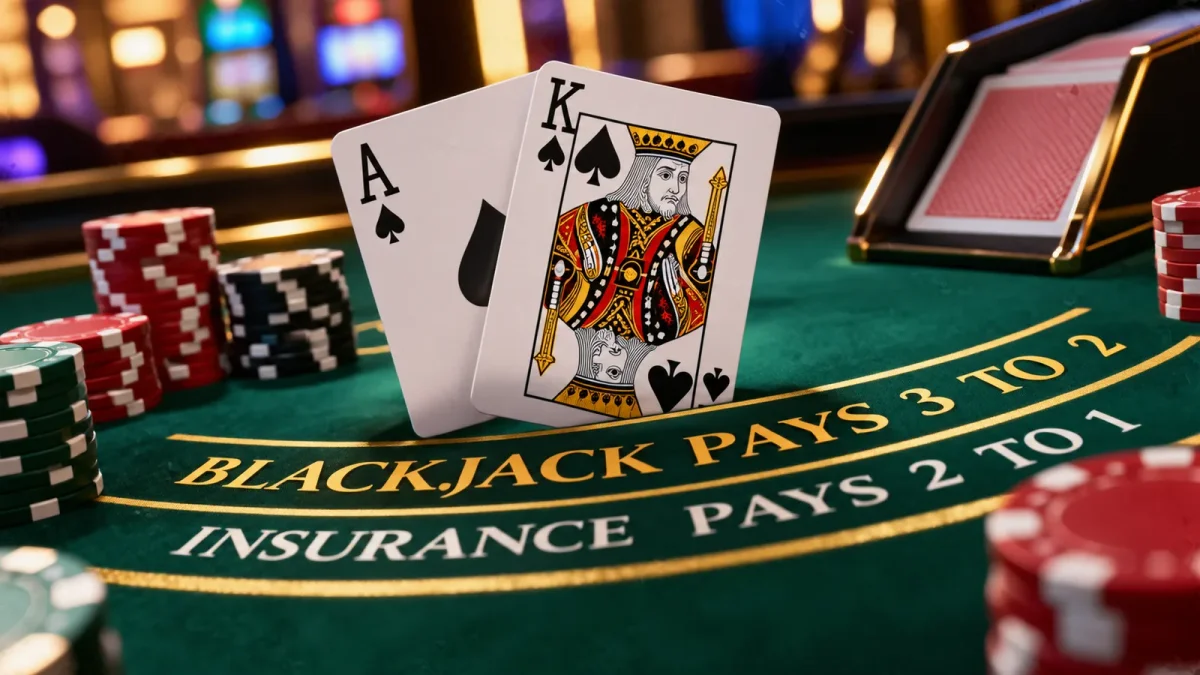
Learning how to play blackjack starts with one rule that beginners often get wrong: the objective is not simply to reach 21. The objective is to beat the dealer without your own hand exceeding 21.
That can happen because the player's final total is higher than the dealer's, or because the dealer goes over 21 while the player remains in the hand. If the player busts first, the wager is lost immediately, even if the dealer later busts as well. MGM's current blackjack guide describes the same dealer-versus-player structure and notes that players do not compete against the other people at the table.
The basic rules take only a few minutes to learn. The complication comes later because blackjack is not one completely standardised game. The number of decks, blackjack payout, dealer's soft-17 rule, doubling restrictions, surrender and treatment of split hands can all change from one table to another.
This guide covers blackjack for beginners from the first two cards through every normal player decision, while separating the rules that are nearly universal from the rules that must be checked at the individual table.
Blackjack Rules at a Glance
Blackjack is played against the dealer, and any hand above 21 loses. Number cards keep their printed value, face cards are worth 10 and an Ace can count as either 1 or 11.
| Rule | What it means |
|---|---|
| Objective | Beat the dealer without exceeding 21 |
| Cards 2–10 | Worth their face value |
| Jack, Queen, King | Worth 10 |
| Ace | Worth 1 or 11 |
| Blackjack | Ace + any 10-value card as the first two cards |
| Bust | Hand total exceeds 21 |
| Hit | Take another card |
| Stand | Take no more cards |
| Double down | Increase the original wager and receive one final card |
| Split | Turn an eligible pair into two separate hands |
| Surrender | Give up the hand and normally lose half the original wager, if offered |
| Push | Player and dealer tie; the original wager is returned |
| Regular winning hand | Normally pays 1:1 |
| Natural blackjack | Commonly 3:2, but 6:5 and other rule sets exist |
The first important habit is therefore checking the actual rules before treating any strategy chart as universal. Regulators such as the UK Gambling Commission require casino game rules and information about the house edge to be made available to players, precisely because individual rules affect the mathematics of the game.
Blackjack Card Values
There are only three blackjack card-value rules to remember: 2–10 count at face value, Jacks, Queens and Kings count as 10, and Aces count as 1 or 11. Suits have no effect on the value of a blackjack hand.
| Card | Blackjack value | Example |
|---|---|---|
| 2–9 | Printed value | 7 = 7 |
| 10 | 10 | 10 + 6 = 16 |
| Jack | 10 | J + 7 = 17 |
| Queen | 10 | Q + 9 = 19 |
| King | 10 | K + 8 = 18 |
| Ace | 1 or 11 | A + 6 can equal 7 or 17 |
The Ace is what creates soft hands. For example, Ace + 6 is called soft 17 because the Ace can currently count as 11, producing 17, but can drop to 1 if another card would otherwise make the hand bust. Official live-blackjack documentation likewise defines an Ace as 1 or 11 and a soft hand as one containing an Ace valued at 11.
What is a hard hand?
A hard hand has no Ace that can currently count as 11 without causing a bust. A 10 + 6 is hard 16. Ace + 5 + 10 is also hard 16 because the Ace must now count as 1.
Hard totals are less flexible because taking another card can immediately take the hand above 21.
What is a soft hand?
A soft hand contains an Ace currently counted as 11. Ace + 7 is soft 18. If a 9 arrives, the Ace changes from 11 to 1 and the total becomes 17 rather than 27.
This distinction matters because the correct hit, stand or double decision can differ substantially between two hands with the same displayed total.
What Counts as Blackjack?
A blackjack, or natural blackjack, is an Ace plus a 10-value card dealt as the player's first two cards. That means A + 10, A + J, A + Q and A + K are all blackjack.
A three-card total of 21 is not a natural blackjack. For example:
| Hand | Total | Natural blackjack? |
|---|---|---|
| A + K | 21 | Yes |
| A + 10 | 21 | Yes |
| 7 + 7 + 7 | 21 | No |
| 5 + 6 + 10 | 21 | No |
| A + 5 + 5 | 21 | No |
The distinction matters because natural blackjack normally receives a special payout and generally beats an ordinary multi-card 21. If both player and dealer have natural blackjack, the usual result is a push.
How Does Blackjack Work?
A normal round moves through the same basic sequence: wager, initial deal, player decisions, dealer action and settlement. Online RNG blackjack and live dealer blackjack may look different on screen, but the central hand structure remains recognisable.
Here is how to play blackjack step by step:
- The wager is placed. The table's minimum, maximum and any optional side bets should be visible before the round begins.
- The initial cards are dealt. The player normally receives two cards. In a common hole-card game, the dealer receives one exposed card and one face-down card; European no-hole-card versions handle the dealer's second card differently.
- Natural blackjack is checked. Depending on the rules and the dealer's upcard, the dealer may check for blackjack before the player makes further decisions.
- The player acts. Available choices may include hit, stand, double down, split and surrender.
- The dealer completes the hand. Dealers do not make strategic choices; they draw or stand according to fixed table rules.
- The hands are compared. Remaining player hands either win, lose or push, and the corresponding payout is applied.
The current MGM rules guide confirms the same core sequence and notes that dealer behaviour is fixed rather than discretionary.
For broader explanations of live tables, RNG games and other formats, Casino Critic's casino games guides cover the wider game library and terminology.
Hit or Stand in Blackjack
Hit means taking another card; stand means keeping the current hand and ending your turn. These are the two decisions that appear most frequently in blackjack.
The question is not simply whether the player's total looks “high” or “low”. The dealer's exposed card matters because blackjack strategy compares the player's hand with the dealer's upcard.
A hard 16 against a dealer 6, for example, represents a different situation from hard 16 against a dealer 10. The hand has the same numerical value, but the dealer's likely outcomes are different. Mathematical dealer-outcome tables show how sharply bust probabilities change across dealer upcards.
What happens when you hit?
Choosing hit adds one card to the hand. If the new total remains below 21, another decision may be available. If it reaches exactly 21, no further card is necessary. If it exceeds 21, the hand busts and loses immediately.
There is generally no fixed limit on the number of ordinary hits a player may take, although special rules can exist in individual variants.
What happens when you stand?
Choosing stand means accepting the current total and taking no more cards. The hand remains active while the dealer completes their own hand.
Standing does not mean the total must be close to 21. Basic strategy can call for standing on relatively low totals when the dealer shows a weak upcard because drawing another card can be less favourable than letting the dealer complete the hand.
What Does Double Down Mean?
Doubling down increases the original wager and gives the player exactly one additional card, after which the hand automatically stands.
At a conventional table, a $10 initial wager that is fully doubled becomes a $20 total wager on that hand. The extra stake creates more financial exposure, so doubling should not be confused with a free strategic option.
Table rules can differ substantially. A game may allow doubling:
| Rule | Meaning |
|---|---|
| Double on any two cards | Any initial two-card total can be doubled |
| Double 9–11 | Only totals of 9, 10 or 11 qualify |
| Double 10–11 | Only totals of 10 or 11 qualify |
| DAS | Doubling after a split is allowed |
| No DAS | Split hands cannot subsequently be doubled |
MGM's standard guide describes double down as increasing the wager and committing to take only one additional card.
Because the availability of doubling changes basic strategy, a strategy chart should match the table's actual rules rather than being applied blindly.
How Does Splitting Work?
Splitting turns an eligible two-card starting hand into two separate blackjack hands. A second wager, normally equal to the original wager, is required to create the second hand.
If two 8s are split, for example, each 8 becomes the first card of a separate hand. A new card is then dealt to each, and those hands are played independently according to the table's splitting rules.
There are several important restrictions to check.
| Split rule | Why it matters |
|---|---|
| Maximum number of splits | Controls how many hands can be created |
| Re-splitting allowed | Determines whether another matching card can be split again |
| Re-splitting Aces | Often treated differently from other pairs |
| One card to split Aces | A common restriction |
| Double after split | Changes the available strategy on new hands |
| Same rank vs same value | Some implementations differ on which cards qualify as a pair |
Split Aces commonly receive only one additional card each. A 10-value card dealt to a split Ace normally creates a total of 21 rather than a natural blackjack, so it usually receives the ordinary winning-hand payout rather than the blackjack premium. MGM similarly notes that a 21 created after splitting does not receive a blackjack payout under its rules.
What Does Surrender Mean?
Surrender lets a player abandon an eligible starting hand and normally forfeit half of the original wager instead of playing the hand to completion. It is not offered at every blackjack table.
The two main versions are early surrender and late surrender.
With late surrender, the dealer first establishes that the dealer does not have blackjack. Early surrender occurs before that check and is much less common because it is more favourable to the player.
If surrender is unavailable, the normal hit, stand, double or split rules apply instead.
What Is Blackjack Insurance?
Insurance is a separate side bet offered when the dealer's exposed card is an Ace. It normally allows a wager of up to half the original blackjack stake and pays 2:1 if the dealer's hidden card completes a natural blackjack.
Suppose the main wager is $10. Insurance may permit an additional wager of up to $5. If the dealer has blackjack, a winning $5 insurance wager produces $10 in insurance profit, while the main $10 hand normally loses unless the player also has blackjack.
That does not make insurance protection against losing in the ordinary sense. It is a separate wager on whether the dealer's unseen card is worth 10.
For a beginner learning how blackjack works, the simplest distinction is:
main hand = attempt to beat the dealer; insurance = separate bet on dealer blackjack.
What Is Even Money?
Even money is typically offered when the player already has blackjack and the dealer shows an Ace. Accepting it produces an immediate 1:1 result on the original wager instead of waiting to see whether the dealer also has blackjack.
Mathematically, even money is effectively the same insurance decision presented in a different form. The player gives up the possibility of receiving the normal blackjack premium in exchange for a fixed even-money settlement.
Availability and presentation can vary by game.
Dealer Rules in Blackjack
The dealer does not choose whether to hit or stand. The table rules make that decision automatically. Dealers generally continue drawing below 17, while the treatment of soft 17 varies.
Two abbreviations appear frequently:
S17 means the dealer stands on all 17s, including soft 17.
H17 means the dealer hits soft 17, such as A + 6.
The difference is small enough to overlook but large enough to change the mathematics and some basic-strategy decisions. MGM explicitly notes that some blackjack variations require the dealer to hit soft 17, while others do not.
That is why “the dealer always stands on 17” is not a complete blackjack rule.
Blackjack Payouts
An ordinary winning hand generally pays 1:1, while natural blackjack may pay 3:2, 6:5 or another amount stated by the table. The payout should be checked before play because it directly changes the value of a natural blackjack.
| Result | Typical settlement |
|---|---|
| Regular win at 1:1 | $10 profit + $10 original wager returned |
| Blackjack at 3:2 | $15 profit + $10 original wager returned |
| Blackjack at 6:5 | $12 profit + $10 original wager returned |
| Push | Original $10 wager returned |
| Loss | $10 wager lost |
| Insurance win at 2:1 | $10 profit on a $5 insurance wager |
Both 3:2 and 6:5 blackjack tables exist, and the payout is normally displayed as part of the game's rules.
A 6:5 table pays less for exactly the same natural blackjack than a 3:2 table. That difference should be treated as a rule change, not as cosmetic wording on the table felt.
Blackjack vs 21
“Blackjack” and “21” are often used as names for the same game, but a hand totaling 21 is not always a blackjack.
The distinction is simple:
A + 10-value card on the first two cards = blackjack.
Any other combination totaling 21 = ordinary 21.
A 7 + 7 + 7 hand therefore reaches 21 but is not blackjack. The difference matters primarily for priority and payout.
Blackjack for Beginners – Which Decisions Matter Most?
A beginner does not need to memorise every possible combination before understanding the game, but the relationship between the player's hand and dealer's upcard is essential.
Under common multi-deck rules, several broad basic-strategy patterns illustrate how decisions work:
| Situation | Common basic-strategy principle |
|---|---|
| Hard 17 or higher | Stand |
| Hard 8 or lower | Hit |
| Pair of Aces | Split |
| Pair of 8s | Split |
| Pair of 10-value cards | Usually stand rather than split |
| Pair of 5s | Usually treated as hard 10 rather than split |
| Strong dealer upcard | Weak player totals are hit more often |
| Weak dealer upcard | More borderline hard totals are stood on |
These are illustrations, not a universal strategy chart. The mathematically correct decision can change with the number of decks, H17/S17, double-after-split rules, surrender availability and other conditions. House-edge calculators therefore ask for these individual rules before producing a result.
Basic strategy does not predict which card comes next and does not guarantee a winning hand or session. It is simply a mathematically derived way of choosing among the legal decisions available under a specified rule set.
Rules That Change Between Blackjack Tables
Two games both labelled “Blackjack” can have meaningfully different rules. Before applying any strategy, check the information panel or table placard for the exact version being offered.
| Rule to check | Examples |
|---|---|
| Blackjack payout | 3:2, 6:5 |
| Number of decks | 1, 2, 6, 8 or another configuration |
| Soft 17 | Dealer stands or hits |
| Dealer hole card | Hole-card or no-hole-card format |
| Doubling | Any two cards or restricted totals |
| Double after split | Allowed or prohibited |
| Re-splitting | Number of permitted split hands |
| Split Aces | One-card restriction, re-split rules |
| Surrender | None, late or occasionally early |
| Side bets | Perfect Pairs, 21+3 and other optional wagers |
Modern live blackjack can introduce further variant-specific mechanics. Evolution, for example, currently offers formats including Infinite Blackjack and versions with Six Card Charlie or multiple optional side bets. These should be treated as separate variants rather than assumed to follow every rule of classic blackjack.
American vs European Blackjack
One of the most important structural differences is whether the dealer receives a hole card before players act.
In a common American-style game, the dealer receives a second card face down and may check for blackjack when showing an Ace or 10-value card.
In a European no-hole-card game, the dealer may not receive the second card until after player decisions have been completed. That distinction can matter if the player has already doubled or split and the dealer later reveals blackjack.
Exact treatment of additional wagers varies by the rule set, so the game's own rules take priority. Dealer probability models also distinguish between US rules where blackjack has already been checked and European rules where it has not.
What Happens When the Dealer Busts?
If the dealer's final hand exceeds 21, every player hand still active normally wins. A player who already busted does not come back into the round.
This order is fundamental to blackjack's house advantage: the player acts first and loses immediately upon exceeding 21. The UK Gambling Commission classifies blackjack as a banker game with an inherent house advantage rather than an equal-chance game.
A dealer bust is therefore relevant only to hands that have survived their own decisions.
What Is a Push?
A push is a tie between an eligible player hand and the dealer. The original main wager is normally returned, with no win or loss on that wager.
Examples include player 19 versus dealer 19 or player 20 versus dealer 20.
Two natural blackjacks also normally push. However, variant-specific side bets are settled separately according to their own rules.
Side Bets Are Separate Games
Side bets such as Perfect Pairs, 21+3, Any Pair or Bust It are not part of the core blackjack wager. They have their own qualifying combinations, payouts and mathematical house edge.
Evolution's current blackjack portfolio, for example, offers several of these side bets alongside the standard main hand.
A beginner trying to understand blackjack rules should learn the main game first. A side bet can win while the main hand loses, or lose while the main hand wins, because the two bets are settled independently.
Does Basic Strategy Remove the House Edge?
No. Basic strategy can reduce avoidable decision errors, but blackjack remains gambling and the exact game retains a mathematical house edge under normal casino rules.
The actual percentage depends on the table configuration. Number of decks, 3:2 versus 6:5 payout, H17 versus S17, doubling rules, surrender and split restrictions can all alter the result. The UK Gambling Commission describes the house edge as the long-term mathematical advantage retained by the casino in banker games such as blackjack.
It is also important to separate expected long-term mathematics from a single session. A statistically correct decision can still lose immediately because the next card is random. MGM makes the same point in its GameSense material: correct play does not control which cards are dealt or guarantee a winning outcome.
Blackjack and Casino Bonuses
Blackjack may count differently from slots toward a casino bonus wagering requirement, and some promotions exclude table games altogether. A bonus should therefore not be assumed to work normally at a blackjack table simply because the game accepts the bonus balance.
Game contribution can materially change the amount of real wagering required. Casino Critic's guide to casino wagering requirements explains why table and live games can contribute at lower percentages than slots and why the eligible-game list needs to be checked before using promotional funds.
This does not change the blackjack rules themselves. It changes how the casino promotion accounts for the wager.
RNG Blackjack vs Live Blackjack
RNG blackjack uses software to generate game outcomes, while live blackjack uses physical cards and a streamed dealer, but either format can follow conventional blackjack rules or a modified variant.
The visual format alone therefore does not tell a player whether blackjack pays 3:2, whether the dealer hits soft 17 or whether surrender is available. Those details remain table-specific.
Evolution's First Person Blackjack, for example, uses an RNG-driven 3D environment while providing an option to move into live-dealer blackjack. Its live portfolio includes conventional and modified variants with different features.
For anyone learning how to play blackjack, the rules panel matters more than whether the dealer is digital or human.
Common Blackjack Terms
Most blackjack terminology describes either the value of a hand or one of the decisions already covered above.
| Term | Meaning |
|---|---|
| Blackjack / natural | Ace plus a 10-value card as the first two cards |
| Bust | Go above 21 |
| Hard hand | No usable Ace counted as 11 |
| Soft hand | Contains an Ace currently counted as 11 |
| Hit | Take another card |
| Stand | Take no more cards |
| Double down | Increase the wager and receive one final card |
| Split | Divide an eligible pair into two hands |
| Surrender | End the hand for a partial loss if the rule is offered |
| Insurance | Side bet on the dealer having blackjack |
| Push | Tie; original wager returned |
| Upcard | Dealer's visible card |
| Hole card | Dealer's face-down card in hole-card blackjack |
| S17 | Dealer stands on soft 17 |
| H17 | Dealer hits soft 17 |
| DAS | Double after split |
| 3:2 | Common premium payout for a natural blackjack |
Once these terms are familiar, most table instructions become considerably easier to read.
How to Play Blackjack Without Misreading the Rules
The safest way to approach a new blackjack table is to read its specific rules before placing a wager. Do not assume that a game behaves identically because the layout looks familiar.
The most important checks are the blackjack payout, dealer soft-17 rule, doubling restrictions, split rules, surrender availability and whether the dealer uses a hole card.
If real money is involved, the spending decision matters more than learning another strategy exception. Casino Critic's responsible gambling guide covers deposit, loss and time limits, warning signs and self-exclusion resources. Gambling should be treated as paid entertainment, not as a method of generating income.
Final Takeaway
Blackjack is simple at its core: beat the dealer without going over 21. The cards are easy to value, and the ordinary player choices are hit, stand, double down, split and, where available, surrender. Insurance is a separate side bet rather than a normal hand decision.
The part that deserves more attention is the table rules. A natural blackjack can pay 3:2 or 6:5; the dealer can stand or hit soft 17; doubling and splitting can be restricted; and no-hole-card games can settle dealer blackjack differently.
For blackjack beginners, that leads to one practical principle: learn the mechanics first, check the exact rules second and only then use a basic-strategy chart built for that rule set. Strategy can reduce decision errors, but no decision removes randomness or guarantees a particular result.