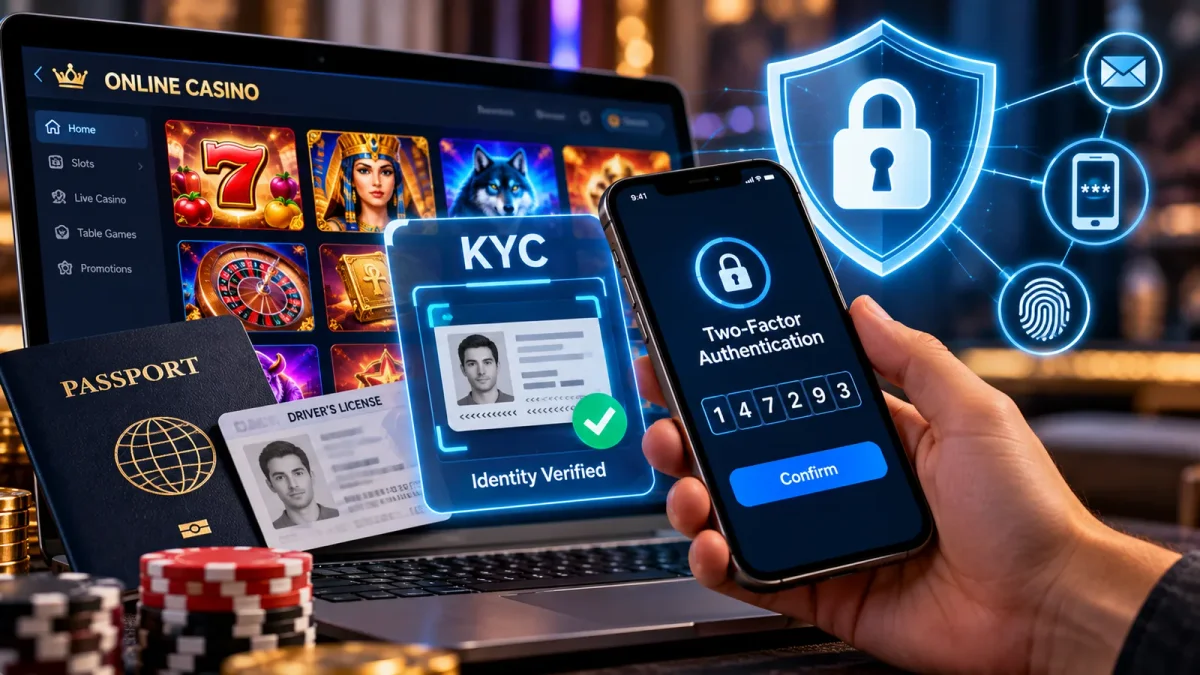
Casinos prevent fraud through layers of security rather than one universal fraud detector. A regulated online casino can verify identity, authenticate logins, examine devices and locations, analyse deposits and withdrawals, identify linked accounts, monitor unusual transactions and investigate whether gambling funds actually belong to the player using them.
Those controls protect both sides of a transaction. Casinos need to stop stolen cards, false identities, money mules, multi-accounting, money laundering and other abuse, while legitimate players need protection against hacked accounts, unauthorised withdrawals and identity theft. Regulators increasingly expect operators to detect suspicious behaviour throughout the customer relationship rather than waiting until a large withdrawal appears.
The threat is also becoming more sophisticated. Fraudsters can use compromised databases, automated login attacks, synthetic identities, altered bank statements and increasingly convincing AI-generated identity material. In 2026, the UK Gambling Commission specifically identified false documentation, deepfake videos and face swaps generated with AI among the emerging threats facing remote casinos.
What Types of Fraud Do Casinos Actually Face?
Casino fraud is much broader than cheating a slot or trying to exploit a promotion. A modern gambling account combines identity data, payment information and real money, making it attractive to criminals interested in stealing accounts or moving funds rather than genuinely gambling.
Some schemes attack the player directly, while others use the casino as part of the fraud.
| Fraud Type | What Happens | Typical Casino Defence |
|---|---|---|
| Account takeover | Criminal gains access to a real player's account | MFA, login and device monitoring |
| Identity theft | Stolen personal details are used to open accounts | KYC and identity verification |
| Fake identity | Forged or synthetic information is submitted | Document and database verification |
| Stolen payment method | Another person's card or account funds gambling | Payment ownership checks |
| Multi-accounting | One person controls multiple accounts | Device, identity and account-link analysis |
| Money mule activity | Another person's account moves criminal funds | Transaction and source-of-funds monitoring |
| Money laundering | Gambling is used to disguise the origin of money | AML monitoring and enhanced due diligence |
| Bonus abuse | Multiple accounts or identities repeatedly claim promotions | Account-link and eligibility checks |
| Location spoofing | Player disguises physical location | Geolocation and proxy detection |
| Chargeback fraud | Legitimate gambling transactions are falsely disputed | Payment and session records |
| Collusion | Players cooperate to transfer value or manipulate peer games | Gameplay and relationship analysis |
| AI identity fraud | Deepfakes or generated documents target KYC | Layered identity and liveness verification |
The important point is that KYC solves only part of the problem. A person can successfully verify a genuine identity and still have that account stolen later, while a genuine account can also be used to move money belonging to somebody else.
This is why fraud prevention continues after registration.
How Casino Fraud Prevention Works from Registration to Withdrawal
A useful way to understand casino fraud prevention is to follow the money through the account. Different controls become important when the player registers, logs in, deposits, gambles and eventually requests a withdrawal.
The exact technologies are not publicly disclosed by most casinos because publishing detection thresholds would make them easier to defeat. Regulatory standards, enforcement cases and official guidance nevertheless reveal a great deal about the controls legitimate operators are expected to maintain.
| Player Stage | Main Fraud Risk | Common Control |
|---|---|---|
| Registration | Fake/stolen identity | KYC |
| Login | Account takeover | Password + MFA |
| Device access | Shared or compromised account | Device monitoring |
| Location | Illegal or spoofed access | Geolocation |
| Deposit | Stolen/third-party funds | Payment verification |
| Gameplay | Laundering, collusion, unusual behaviour | Transaction/gameplay monitoring |
| High spending | Unexplained source of money | Source-of-funds checks |
| Withdrawal | Account takeover or suspicious fund movement | Authentication and withdrawal review |
| Ongoing account use | New risk appearing later | Continuous monitoring |
This layered approach matters because criminals rarely attack every part of the system simultaneously. If one security barrier fails, another may still prevent money from leaving the account.
1. KYC Checks Whether the Player Is a Real Person
Know Your Customer, or KYC, establishes who controls an account. Depending on the jurisdiction and level of risk, verification can use a legal name, date of birth, residential address, government-issued identification and independent electronic information.
KYC also serves purposes beyond fraud prevention. It helps casinos prevent underage gambling, identify people subject to exclusion requirements and meet anti-money-laundering obligations. A regulated operator therefore cannot simply treat every email address as an anonymous gambling account.
The important distinction is between collecting identity data and verifying it. A criminal can type someone else's name into a registration form, so effective controls need to establish that the information corresponds to the person actually creating or operating the account.
2. MFA Helps Stop Stolen Casino Accounts
A correct username and password are no longer strong proof that the legitimate player is logging in. Passwords are regularly exposed through phishing, malware and breaches of unrelated websites, and many people reuse credentials across several services.
This creates a casino fraud method known as credential stuffing. Criminals take username-password combinations stolen elsewhere and automatically test them against gambling platforms, hoping to find accounts where the player reused the same credentials.
New Jersey's Division of Gaming Enforcement has described credential stuffing as the most prevalent cyberattack against online internet gaming providers. The regulator consequently requires internet gaming operators to implement multi-factor authentication for player logins.
Real US Example – More Than Three Devices Can Trigger Additional Scrutiny
New Jersey provides an unusually concrete example of how device activity can become a fraud signal. The Division of Gaming Enforcement states that if an account becomes associated with more than three devices within 24 hours, the operator is expected to conduct the necessary due diligence to ensure fraud is not involved.
That does not mean a fourth device automatically proves account theft. A player may legitimately change hardware or use several personal devices, so the signal needs context. The point is that unusual device proliferation can justify another security check rather than being ignored.
For a player, MFA is therefore one of the most useful protections available. Even if a password has been compromised, an attacker still needs to defeat another authentication factor before gaining control.
3. Device Analysis Can Connect Accounts That Look Unrelated
Fraudsters rarely want an operator to know that several accounts belong to the same person. They can change email addresses, usernames and registration details to make each account appear independent.
Device information creates another layer of comparison. Depending on the approved system and jurisdiction, operators can analyse device identifiers, operating systems, IP information and relationships between devices and player accounts.
This becomes useful in cases involving multi-accounting, account sharing and organised networks. Five accounts registered under five names may appear unrelated when viewed individually, but repeated connections to the same technical environment can provide a reason to investigate them together.
4. Geolocation Can Detect More Than a Player's Country
In some regulated markets, geolocation is a legal requirement as well as an anti-fraud control. US online casino markets provide particularly strong examples because legal wagering can depend on whether the player is physically inside the relevant state.
Michigan requires sophisticated geofencing capabilities. Official technical standards require systems capable of analysing data including usernames, device identifiers, city, state, country, IP addresses, operating systems and whether location transactions passed or failed.
Michigan also requires reporting capable of identifying repeated or malicious location spoofing, account sharing, device sharing and other high-risk transactional behaviour. The fraud and proxy databases supporting the system must be kept current, and the geolocation system itself has to be regularly updated.
Why a VPN Is Not a Reliable Fraud Bypass
Changing the apparent IP address does not necessarily fool a regulated casino's location system. Modern geolocation can combine several signals rather than relying solely on the country associated with one IP address.
Michigan's standards explicitly contemplate software that could be used to circumvent geolocation. When potential location fraud or circumvention software is detected, the system can generate a failed location result.
Geolocation therefore illustrates a wider fraud-prevention principle: one piece of data is rarely trusted in isolation.
5. Casinos Check Where Deposit Money Comes From
Successfully processing a deposit does not mean the transaction has passed every fraud or AML check. Casinos can examine whether funding methods make sense for the account and whether payment behaviour changes over time.
A payment method belonging to somebody other than the registered player can create particular concern. It may indicate innocent confusion, but it can also involve a stolen card, money mule, account sharing or an attempt to conceal the real source of gambling funds.
This is why legitimate casinos can restrict third-party payments or request additional verification. The objective is to connect the player, gambling account and source of money rather than treating them as three unrelated pieces of information.
6. Transaction Monitoring Looks for Behaviour That Does Not Make Sense
Fraud detection becomes particularly useful when it examines sequences rather than isolated transactions. A $5,000 deposit is not automatically suspicious, and a withdrawal is not automatically suspicious, but depositing a large amount, doing almost no gambling and immediately attempting to move the money somewhere else can create a very different risk profile.
Monitoring can also identify sudden increases in deposits, repeated third-party payments, unusual payment instruments, rapid movement of funds and activity that is inconsistent with what the casino knows about the customer.
These patterns do not automatically prove criminal behaviour. They provide a reason to ask whether the activity has a reasonable explanation and whether additional due diligence is required.
7. Source-of-Funds Checks Ask Where Gambling Money Came From
KYC establishes identity, while source-of-funds checks examine the origin of money used for gambling. The distinction becomes important when an account begins processing amounts that are difficult to reconcile with the available customer information or when another AML risk appears.
Depending on the case and jurisdiction, evidence can relate to salary, business income, investments, savings, asset sales, inheritance or another legitimate source. The casino may also examine bank information for unexplained third-party transfers or inconsistencies.
Source-of-funds verification should therefore not be confused with a universal requirement to prove wealth before every bet. It is typically part of a risk-based compliance process in which higher-risk activity receives more scrutiny.
8. Casinos Look for Multi-Accounting and Mule Networks
Multiple accounts can be used to bypass restrictions, exploit promotions repeatedly or disguise who controls the money. Mule accounts create an additional problem because the person whose identity appears on the account may not be the person actually providing or controlling the funds.
Detecting these arrangements often requires combining several signals. Registration timing, payment sources, devices, addresses and similar gambling patterns may become much more meaningful when they appear together.
This is where behavioural analysis can reveal fraud that a basic identity check misses. Every individual account may initially appear legitimate, while the network connecting them tells a different story.
Real UK Case – £40,000 Deposited Through Five Identities
One UK Gambling Commission case demonstrates how far identity abuse can go. A customer deposited approximately £40,000 over six months while creating accounts using the details of five different individuals.
The same 2026 regulatory assessment describes another customer whose previous account had been blocked because of money-laundering concerns. That person was able to create a new account because the operator's controls failed to detect small discrepancies in signup information.
These examples remain useful in an international article because they illustrate a universal problem rather than a uniquely British rule. Fraud detection needs to recognise connected and near-matching identities, not merely search for perfectly identical names.
Real UK Case – Student Accounts Showed Signs of Money-Mule Activity
The UK Gambling Commission also describes a group of students suspected of acting as money mules. Their accounts displayed similar wagering patterns and high returns, while investigation found additional connections involving registration timing and source of funds.
No single one of those characteristics would necessarily prove fraud. Several students can legitimately enjoy the same games, and similar behaviour alone is not enough to establish wrongdoing.
The strength of the fraud signal came from the combination of factors. Identity, timing, funding and behaviour became more informative when analysed together.
9. Withdrawal Checks Protect Accounts but Need a Genuine Reason
Withdrawals are a critical fraud point because this is where money leaves the casino environment. An attacker who has taken over a funded account may try to change payment information and withdraw the balance rather than spend time gambling.
Additional authentication or investigation can therefore be legitimate when a real risk signal exists. However, regulated fraud prevention should not become an excuse to create arbitrary withdrawal obstacles only after a player wins.
Michigan provides an important player-protection example. When an operator investigates a withdrawal for suspected fraudulent conduct, it must maintain sufficient documentation supporting its good-faith belief and provide notices concerning the investigation.
The regulator has specifically noted cases where withdrawal requests were flagged for reasons with no clear connection to the withdrawal itself. This distinction is important for players because legitimate fraud controls should be evidence-based rather than an unlimited justification for delaying payment.
How Casinos Prevent Fraud in the United States
The United States provides some of the clearest examples of technology-driven online casino security because regulated internet gaming operates under detailed state requirements.
New Jersey focuses strongly on identity security and account takeover. MFA is mandatory for internet gaming logins, credential stuffing is specifically recognised as a threat and unusual device activity can require additional investigation.
Michigan adds extensive geolocation controls. Its technical framework specifically targets location spoofing, account sharing and device sharing, while its withdrawal rules require operators to document a genuine fraud concern rather than merely declaring a transaction suspicious.
Licensed vs Unlicensed Casinos – Michigan's Real Examples
Regulation also determines what happens when something goes wrong. In 2025, the Michigan Gaming Control Board took action against numerous unlicensed online gambling sites, including Club Player Casino, 7 Bets Casino, Cherry Jackpot Casino, Wild Vegas Casino, VIP Slots Casino and others.
The regulator warned that unlicensed platforms can expose consumers to withheld winnings, denial of withdrawals, questionable wagering conditions, data breaches and identity theft. Licensed operators, by contrast, operate inside a system containing identity, technical, geolocation and complaint requirements.
This creates an important security lesson. A website can look professional and still operate outside the fraud-protection framework applicable to licensed casinos.
How Casinos Prevent Fraud in Canada
Canadian casino fraud prevention operates within federal AML requirements as well as provincial gambling regulation. Casinos are among the sectors subject to Canada's Proceeds of Crime (Money Laundering) and Terrorist Financing framework and have obligations involving customer identification, records and suspicious transaction reporting.
Ontario's gaming standards illustrate the operational side. Operators are expected to maintain mechanisms for identifying and preventing unlawful activity, conduct risk assessments covering money laundering, fraud, theft and cheating, monitor player and employee transactions and analyse suspicious transactions.
This means fraud prevention extends beyond the moment an account is verified. Ontario's regulatory approach expects continuing analysis of what happens on the gambling platform.
Real Canadian Case – Atlantic Lottery Fined C$212,025
In July 2026, Canada's financial intelligence regulator FINTRAC announced a C$212,025 administrative monetary penalty against Atlantic Lottery Corporation following a compliance examination.
Among the violations identified by FINTRAC was failure to submit a suspicious transaction report where reasonable grounds existed to suspect a transaction or attempted transaction was related to money laundering or terrorist activity financing. FINTRAC also identified a failure relating to up-to-date written compliance policies and procedures.
The case is useful because Atlantic Lottery is a real regulated gambling organisation rather than a hypothetical casino. It demonstrates that regulators do not simply expect operators to collect player details – they expect suspicious financial activity to be recognised, investigated through the applicable compliance process and reported when legal thresholds are met.
How Casinos Prevent Fraud in Malta and the European Remote-Gaming Market
Malta is particularly relevant to international online casinos because many remote gaming businesses operate under Malta Gaming Authority licences. The MGA requires relevant B2C gaming licensees to use a risk-based AML/CFT framework rather than treating every customer and transaction as presenting identical risk.
The framework includes customer due diligence, customer acceptance policies and ongoing monitoring. Malta's Financial Intelligence Analysis Unit has also issued remote-gaming guidance dealing with verification of identity, politically exposed persons, ongoing monitoring and situations where a customer refuses to provide required information or documentation.
This model helps explain why verification can intensify later in an account relationship. A player who initially presents little risk can trigger new questions if transaction volume, payment behaviour or other circumstances change substantially.
Expected Activity Can Matter
Maltese AML guidance expects remote gaming operators to understand the anticipated level of activity associated with a customer. That can include expected value and frequency of transactions throughout the relationship.
If actual activity changes dramatically, the operator may need to examine whether its existing understanding of the customer remains reasonable. Expired identity documents and inconsistencies in existing customer information are also examples of issues that ongoing monitoring can address.
This is another reason KYC should not be thought of as a single checkbox completed permanently on registration day.
Real European Industry Case – Evolution Malta Holding
Fraud and financial-crime controls do not apply only to players. Gambling businesses also need to understand the companies with which they conduct business and where their games ultimately appear.
In July 2026, the UK Gambling Commission announced a £4.75 million regulatory settlement involving Evolution Malta Holding Limited. The regulator found that genuine Evolution games had appeared on six websites operated by two businesses that were not licensed by the Gambling Commission but were accessible to consumers in Great Britain.
The Commission identified deficiencies involving risk assessment, policies and controls, and customer due diligence relating to the businesses receiving the games. Evolution subsequently geo-blocked its games from the affected unlicensed websites, illustrating that fraud and financial-crime controls can extend through the B2B supply chain as well as individual player accounts.
How Casinos Prevent Fraud in Ukraine
Ukraine's regulated gambling system requires operators to identify players and maintain account information that connects gambling activity with an identifiable customer. The country's regulatory framework has also moved toward more centralised online monitoring.
A notable development arrived in May 2026, when a new algorithm for generating a unique player identifier took effect. PlayCity explains that the identifier is generated by transforming a set of information about the player so that information can be transferred to the State Online Monitoring System in a depersonalised form while taking personal-data requirements into account.
This creates an important regulatory infrastructure layer. The objective is not merely for each casino to maintain an isolated username but to make regulated gambling activity compatible with state monitoring while preserving the required treatment of personal data.
Why Player Identification Matters for Fraud Prevention in Ukraine
Ukraine's gambling legislation defines the player account as part of the operator's online system containing information necessary to identify the player. Identification is therefore built into the legal architecture of regulated online gambling rather than being an optional casino security feature.
That can help separate licensed gambling from anonymous account structures that are easier to abuse. Identity controls can also support restrictions involving people who should not have access to gambling and provide a clearer audit trail for account transactions.
The exact anti-fraud technology used by individual Ukrainian casinos should not be assumed unless publicly confirmed. The useful verified point is that regulated operators operate within statutory identification and increasingly centralised monitoring requirements.
How Casinos Prevent Fraud in Australia
Australia is different because conventional online casino services cannot legally be offered to people in Australia under the country's interactive gambling framework. However, Australia's AML regulator AUSTRAC provides detailed fraud and suspicious-activity guidance for legal gambling and wagering businesses, making it useful for understanding transaction monitoring.
AUSTRAC identifies warning signs such as false or unverifiable identification, refusal to provide requested source-of-funds information, frequent changes to account details and inconsistencies between contact information and claimed location.
Its guidance also emphasises suspicious matter reporting. Where a regulated business forms the required level of suspicion, it must report the matter to AUSTRAC rather than simply treating the behaviour as an internal casino issue.
Real Australian Example – Deposit, No Betting, Different Withdrawal Account
AUSTRAC publishes a worked example involving an online wagering customer who deposits $8,000 by credit card but places no wagers. A week later, the customer asks to withdraw the money and close the account, but when the card cannot receive the transfer, asks for the money to be sent to a bank account instead.
The operator's transaction-monitoring system identifies the behaviour as suspicious and applies enhanced customer due diligence. The customer is asked to provide evidence that the nominated bank account belongs to him.
How Casinos Prevent Fraud in Asia
Asia cannot be treated as one gambling jurisdiction. Singapore maintains a tightly controlled gambling environment, while the Philippines has its own casino AML framework covering both physical and internet-based casino activity.
Both markets provide useful real examples of fraud and money-laundering controls. They also show that Asian casino regulation can be highly detailed rather than relying solely on basic ID checks.
Singapore – Customer Due Diligence Can Carry Million-Dollar Consequences
Singapore's Gambling Regulatory Authority requires casino operators to maintain frameworks for preventing money laundering, terrorism financing and proliferation financing. High-risk patrons must be identified and managed using factors including their profiles and behaviour.
Singapore has also strengthened information sharing between casino operators in higher-risk cases. Regulatory changes allow relevant patron information to be shared more directly where necessary to address financial-crime risks, while the regulator retains oversight.
This creates a system in which suspicious behaviour at one casino does not necessarily exist in an informational vacuum.
Real Singapore Case – Resorts World Sentosa Fined S$2.25 Million
The Gambling Regulatory Authority's enforcement records show a particularly significant case involving Resorts World at Sentosa Pte. Ltd.
For FY2023, GRA recorded a breach involving failure to perform prescribed customer due diligence measures. The financial penalty was S$2.25 million.
Earlier enforcement records also show separate Resorts World Sentosa penalties involving failures to perform customer due diligence and enhanced customer due diligence.
The significance is straightforward. KYC and AML checks at a major regulated casino are not merely internal company policies – failure to perform them can become a multimillion-dollar regulatory matter.
Singapore – Real Gambling and Bank-Account Fraud Cases
Singapore Police cases also demonstrate how gambling can intersect with stolen or misused funds.
In June 2026, police announced that 11 people aged 17 to 23 were being investigated over suspected illegal online gambling and misuse of bank accounts. Some were suspected of obtaining illegal online betting accounts for other people, while others allegedly provided personal bank accounts for monetary transactions connected with unlicensed gambling operators.
Another 2026 enforcement operation identified personal and corporate bank accounts linked to suspected illegal online gambling. Police said shell companies had been used to establish some corporate accounts, while dozens of bank accounts were identified during the investigation.
These are not examples of ordinary players being subjected to casino KYC. They demonstrate why regulators and legitimate operators care about who controls an account, whose bank account moves the money and whether the apparent customer is the real person behind the transaction.
A S$1.7 Million Misappropriation Case Shows the Financial-Crime Connection
Singapore Police described another striking 2026 case involving a former bank branch manager suspected of misappropriating approximately S$1.729 million from a bank vault.

Police said much of the money was handed to another woman, who allegedly used funds at local casinos and illegal remote gambling platforms. The second woman was reported to have cashed in approximately S 790,000 to third-party bank accounts for remote gambling purposes.
The allegations demonstrate why gambling businesses cannot evaluate casino transactions solely by asking whether the customer has money available. The origin, ownership and movement of the funds can be just as important as the amount deposited.
Philippines – Casinos Must Use Electronic AML Monitoring
The Philippines provides another strong Asian example because its casino AML rules explicitly include internet and ship-based casinos. PAGCOR maintains a dedicated Anti-Money Laundering Supervision and Enforcement Department, while the country's Casino Implementing Rules and Regulations set out detailed obligations.
Those rules require casinos to install an electronic AML monitoring system capable of helping them understand normal and reasonable customer account or gaming activity. Transactions are expected to be assessed against what the casino knows about the customer, the customer's gaming behaviour, risk profile and source of funds.
This closely reflects the logic used in other mature gambling markets. A transaction is not evaluated only by its absolute size; it is considered in the context of the person and account behind it.
Anonymous and Fictitious Casino Accounts Are Prohibited
Philippine casino AML rules prohibit anonymous accounts and accounts under fictitious names. Casino accounts must be maintained in the true and full name of the account owner or holder.
The rules also address situations in which one person conducts a casino transaction on behalf of somebody else. Casinos must establish and record the identity of both the account holder or transactor and the beneficial owner or person on whose behalf the transaction is conducted.
That requirement targets a fundamental fraud problem: the visible account holder and the real person controlling the money may not always be the same person.
High-Risk Customers Receive Enhanced Due Diligence
Philippine rules permit aspects of customer identification to involve third parties or outsourced processes under defined conditions, but ultimate responsibility remains with the casino. Higher-risk customers require enhanced due diligence.
This is important because outsourcing identity technology does not outsource regulatory responsibility. A casino cannot simply blame an external verification provider if its own AML and customer-identification obligations are not met.
The same principle appears repeatedly across regulated markets: technology can assist fraud prevention, but the licensed gambling business remains accountable for the result.
How Fraud Prevention Differs Around the World
The core concepts are surprisingly consistent internationally, but individual regulators emphasise different controls.
| Jurisdiction | Particularly Important Controls | Real Regulatory Example |
|---|---|---|
| New Jersey, USA | MFA, credential-stuffing defence, device review | >3 devices/24h can require additional due diligence |
| Michigan, USA | Geolocation, spoofing detection, documented withdrawal investigations | Geofencing specifically monitors location fraud and device sharing |
| Ontario, Canada | Fraud/AML risk assessments and transaction monitoring | Operators expected to analyse suspicious transactions |
| Canada – federal | Suspicious transaction reporting and AML compliance | Atlantic Lottery fined C$212,025 in 2026 |
| Great Britain | KYC, mule detection, source of funds, AI-fraud controls | £40,000 deposited using five identities |
| Malta | Risk-based CDD and ongoing customer monitoring | Remote operators must monitor expected account activity |
| Ukraine | Player identification and state online monitoring | Unique player identifier introduced in 2026 |
| Australia | Customer identification, ECDD and suspicious matter reporting | AUSTRAC example: $8,000 deposit, no bets, alternate withdrawal account |
| Singapore | CDD, ECDD, high-risk patron monitoring | Resorts World Sentosa fined S$2.25 million |
| Philippines | Electronic AML monitoring and beneficial-owner identification | Anonymous/fictitious casino accounts prohibited |
The table shows that there is no single worldwide fraud checklist. The common pattern is layered verification: identity + account access + device/location + payment source + behaviour + withdrawal destination.
The weighting of those layers changes with local law and the type of gambling being offered.
AI Is Making Casino Identity Fraud Harder to Detect
Remote casinos have traditionally relied heavily on digital identity evidence because the customer is not physically standing in front of casino staff. Generative AI makes that model more challenging by reducing the cost of producing convincing fake material.
The UK Gambling Commission's 2026 remote-casino risk assessment explicitly identifies increased attempts to bypass customer due diligence using false documents, AI-generated material, deepfake video and face swaps.
This does not mean casinos publicly disclose exactly how their deepfake detection works. Publishing precise fraud thresholds would help attackers design methods to stay below them.
Instead, the broader direction is toward layered identity verification. Document information, database results, account history, device information and other signals can be compared rather than trusting a single photograph or video in isolation.
What Happens When Casino Fraud Detection Flags an Account?
A fraud alert should normally start an investigation rather than automatically establish guilt. The appropriate response depends on what triggered the alert and how serious the potential risk is.
Possible steps include additional login authentication, identity verification, payment-method checks, source-of-funds requests, examination of linked accounts or temporary restrictions while relevant information is reviewed.
Higher-risk cases can receive enhanced due diligence. Where legal reporting thresholds are met, casinos may also have obligations to submit information to financial-intelligence or law-enforcement authorities.
For legitimate players, this means a request for more information does not necessarily indicate that the casino has concluded fraud occurred. It can mean that existing information is insufficient to resolve a specific risk signal.
Why Do Casinos Sometimes Ask for KYC Again?
KYC is not always a one-time event. Customer information can become outdated, payment behaviour can change and a previously low-risk account can later generate new concerns.
Malta's remote-gaming AML guidance, for example, stresses ongoing monitoring and keeping relevant customer information current. Expired identification or inconsistencies in existing information can require additional attention.
A player who verified an account two years ago should therefore not assume that no legitimate verification request can ever occur again. The more useful question is whether the new request has a reasonable compliance or security purpose and comes through the operator's genuine secure channel.
Why Can Fraud Checks Delay a Withdrawal?
Withdrawals combine several risks at once. Money is leaving the casino, the destination needs to be legitimate and an attacker who has compromised the account may attempt to cash out quickly.
A temporary review can therefore be reasonable where an actual risk indicator exists. Michigan's rules are useful because they also demonstrate the limit of that justification: operators investigating suspected fraudulent conduct need documentation supporting their good-faith belief and must provide appropriate notices during an investigation.
This protects both sides. Casinos retain the ability to investigate genuine fraud, while “security review” should not become an undefined excuse for delaying every large winning withdrawal.
How Can Players Tell Whether a Casino Fraud Check Is Legitimate?
The first question should be whether the casino is actually regulated where it operates. A sophisticated website design, familiar games and a licence logo in the footer are not substitutes for checking an official regulatory register.
Legitimate verification requests should also make sense in context. Identity documents, payment ownership or source-of-funds evidence can have genuine compliance purposes, while requests for passwords, cryptocurrency seed phrases or unrelated banking credentials are very different.
Sensitive documents should be uploaded only through verified secure channels. Players should also retain copies of casino correspondence, withdrawal requests and verification confirmations in case a later dispute needs to be escalated.
How Players Can Reduce Casino Account Fraud
Players control several important security variables themselves. Strong casino security becomes much less effective when the same password is reused across email, shopping, social media and gambling accounts.
A basic account-security routine should include:
- Use a Unique Password. A casino password should not be reused on another website.
- Enable MFA. Multi-factor authentication makes stolen credentials less useful.
- Secure the Connected Email Account. Email access can allow an attacker to reset casino credentials.
- Use Your Own Payment Methods. Third-party payment methods can create security and compliance problems.
- Check the Exact Domain. Phishing sites can closely imitate casino login pages.
- Review New-Device Alerts. Unexpected device activity can indicate account takeover.
- Never Share the Casino Account. Shared access complicates both security and regulatory checks.
- Avoid Location Spoofing. It can trigger fraud controls and violate legal or operator requirements.
- Use Secure KYC Uploads. Do not send sensitive identity documents to unverified contacts.
- Keep Transaction Records. Deposits, withdrawals and verification correspondence can matter in a dispute.
These measures do not affect the mathematical risk of gambling itself. They reduce avoidable cybersecurity, identity and payment risks surrounding the account.
Licensed Casinos and Unregulated Sites Are Not the Same Security Environment
A licence cannot guarantee that an operator will never make a security mistake. What regulation provides is an external set of requirements and an authority capable of investigating failures.
Michigan's enforcement actions against unlicensed operators illustrate the difference. The regulator has warned that illegal casinos can expose players to withheld winnings, withdrawal problems, weak data protection, identity theft and other financial risks.
The distinction becomes particularly important when a website asks for a passport, bank statement or other sensitive information. Before giving a casino enough personal information to verify an identity, a player should verify who makes that casino accountable for protecting the information.
Real Casino Fraud and Compliance Cases Worth Knowing
Actual regulatory cases reveal more than generic claims about “advanced security”. They show what regulators consider serious enough to investigate or penalise.
| Case | What Happened | What It Demonstrates |
|---|---|---|
| UK – five identities | About £40,000 deposited through accounts using five people's details | Identity linking and multi-account detection |
| UK – student mule accounts | Similar funding, registration and wagering patterns connected accounts | Behavioural and network analysis |
| New Jersey | Credential stuffing identified as major online gaming attack | Need for MFA |
| Michigan | Regulations specifically address spoofing and device/account sharing | Geolocation as fraud control |
| Canada – Atlantic Lottery | C$212,025 FINTRAC penalty in 2026 | Suspicious transaction reporting matters |
| Evolution Malta Holding | £4.75m GB settlement in 2026 over games reaching unlicensed sites | B2B due diligence matters |
| Singapore – Resorts World Sentosa | S$2.25m penalty for CDD failures | KYC failures can have major consequences |
| Singapore Police – 2026 | Personal/corporate accounts and shell companies linked to illegal gambling investigations | Bank-account ownership matters |
| Philippines | Anonymous and fictitious casino accounts prohibited | Real identity and beneficial owner matter |
| Australia – AUSTRAC example | $8,000 deposited, no wagers, alternate withdrawal requested | Transaction pattern matters |
The cases come from very different regulatory systems, yet the underlying logic is strikingly similar. Fraud becomes easier to identify when the casino understands who controls the account, where access originates, where the money came from, what happens to it and where it is going next.
That is much more powerful than checking an ID once and assuming the account will remain legitimate forever.
What Casino Fraud Prevention Cannot Do
No casino fraud system can eliminate every attack. Criminal techniques evolve, legitimate identities can be compromised and AI makes digital forgery increasingly accessible.
Security systems can also generate false positives. Travelling can produce a new IP address, replacing a phone creates a new device and several legitimate adults in one household can share an internet connection.
Effective fraud prevention therefore needs proportionate investigation and human oversight rather than assuming every anomaly proves wrongdoing. The objective is to make fraud harder while providing legitimate players with a reasonable way to explain unusual but genuine activity.
Final Takeaway – Modern Casino Fraud Prevention Is Global and Layered
The most effective casino fraud prevention no longer depends on a single KYC check. Regulated operators increasingly combine identity verification, MFA, device analysis, geolocation, payment checks, transaction monitoring, source-of-funds analysis and enhanced due diligence.
Real cases demonstrate why every layer exists. New Jersey has responded to credential-stuffing attacks with MFA requirements, Michigan explicitly monitors location spoofing and account sharing, Canada penalised Atlantic Lottery over AML compliance failures, and Singapore imposed a S$2.25 million penalty on Resorts World Sentosa for customer due diligence failures.
Asian regulation adds further examples. Singapore enforcement cases show how personal and corporate bank accounts can become connected with illegal gambling, while Philippine casino rules require electronic AML monitoring and prohibit anonymous or fictitious accounts.
Ukraine is moving toward centralised monitoring through unique player identifiers, Malta requires risk-based ongoing customer monitoring and Australian AML guidance demonstrates why large deposits followed by little or no gambling can warrant further investigation.
The technology and terminology differ between markets, but the fundamental questions are remarkably consistent:
Is this the real player? Does this person control the account? Where did the money come from? Does the behaviour make sense? And is the money being withdrawn to a legitimate destination?
A regulated casino that can answer those questions has a much stronger chance of stopping fraud before money disappears.